
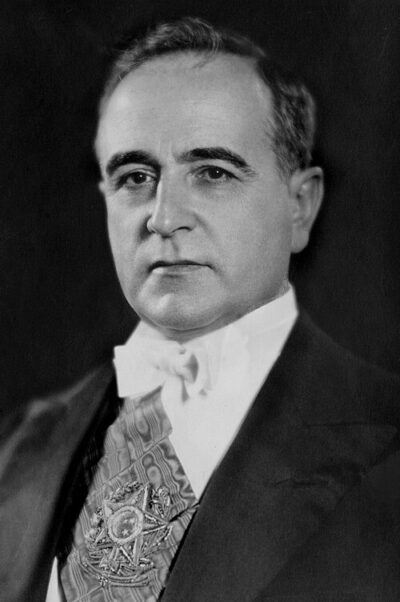
Getúlio Vargas
Getúlio Vargas was a President of Brazil (1930–1945; 1951–1954). Born April 19, 1882, in São Borja. Died August 24, 1954, in Catete Palace. Positions held include federal deputy of Rio Grande do Sul (1923–1926), President of Brazil (2 times) (1930–1954) and member of the Senate of Brazil (1946–1951). Educated at Federal University of Rio Grande do Sul. Awards include Collar of the Order of Isabella the Catholic, Order of the White Eagle and Knight Grand Cross with Collar of the Order of Merit of the Italian Republic.
Facts
44 facts · 2 confirmed by two sources · 14 cited · 28 from one source
Where this comes from
Papalocal keeps its own record. It started from these sources; what each one said is kept here as it was copied, so a change on their side never changes this page by itself. Tap one to read its version.
What Wikidata says · copied November 16, 2026 · revision 2568004793
- Described as
- President of Brazil (1930–1945; 1951–1954)
- Other names
- Getulio Vargas, Getúlio Dornelles Vargas
- Born
- April 19, 1882 · 3 references
- Died
- August 24, 1954 · 6 references
- Born in
- São Borja · 1 reference
- Died in
- Catete Palace
- Buried in
- São Borja
- Cause of death
- gunshot wound
- Citizen of
- Brazil
- Occupation
- lawyer · 1 reference; politician · 1 reference
- Positions held
- federal deputy of Rio Grande do Sul (1923–1926) · 1 reference; President of Brazil (2 times) (1930–1954) · 1 reference; member of the Senate of Brazil (1946–1951)
- Political party
- Brazilian Labour Party (1946–1954); Republican Party of Rio Grande do Sul (1909–1930)
- Education
- Federal University of Rio Grande do Sul
- Member of
- Brazilian Academy of Letters
- Awards
- Collar of the Order of Isabella the Catholic (1952) · 2 references; Order of the White Eagle; Knight Grand Cross with Collar of the Order of Merit of the Italian Republic; Grand Cross Special Class of the Order of Merit of the Federal Republic of Germany (1953); Grand Cross of the Order of the Southern Cross; Order of Naval Merit; Grand Cross of the Military Order of the Tower and Sword · 1 reference; Grand Cross of the Military Order of Avis · 1 reference; Grand Cross with Collar of the Order of the White Rose of Finland (1937) · 1 reference; Livro dos Heróis e Heroínas da Pátria · 1 reference
- Field
- politics · 1 reference; law · 1 reference
- Spouse
- Darci Vargas (1911–1954) · 1 reference
- Children
- Lutero Vargas · 1 reference; Alzira Vargas · 1 reference; Jandira Vargas; Manuel Sarmanho Vargas; Getúlio Vargas Filho
- Father
- Manuel do Nascimento Vargas · 1 reference
- Mother
- Cândida Francisca Dornelles · 1 reference
- Siblings
- Benjamim Vargas; Spartacus Dornelles Vargas; Viriato Dornelles Vargas; Protásio Dornelles Vargas; Jovita Dornelles Vargas
- Religion
- agnosticism
- Military branch
- Brazilian Army · 1 reference
- Military rank
- Sergeant · 1 reference
- Wikipedias with a page
- 83
Wikidata item Q156844 (wikidata.org/wiki/Q156844), public domain (CC0). Copied November 16, 2026.
What Wikipedia says · copied November 16, 2026 · revision 1383625886
Getúlio Dornelles Vargas (19 April 1882 – 24 August 1954) was a Brazilian military officer, lawyer, and politician who served as the 14th and 17th president of Brazil, from 1930 to 1945 and from 1951 until his suicide in 1954. Due to his long and controversial tenure as Brazil's provisional, constitutional, dictatorial and democratic leader, he is considered by historians as the most influential Brazilian politician of the 20th century.
Born on 19 April 1882 in São Borja, Rio Grande do Sul, to a powerful local family, Vargas had a short stint in the Brazilian Army before entering law school. He began his political career as district attorney, soon becoming a state deputy prior to a brief departure from politics. After returning to the state Legislative Assembly, Vargas led troops during Rio Grande do Sul's 1923 civil war. He entered national politics as a member of the Chamber of Deputies. Afterward, Vargas served as Minister of Finance under president Washington Luís before resigning to head Rio Grande do Sul as state president, during which he had an active tenure and introduced many policies.
In 1930, after losing the presidential election, Vargas rose to power under a provisional presidency following an armed revolution, remaining until 1934 when he was elected president under a new constitution. Three years later he seized powers under the pretext of a potential communist insurrection, beginning the eight-year long Estado Novo dictatorship. In 1942, he led Brazil into World War II on the side of the Allies after being sandwiched between Nazi Germany and the United States. Though there was notable opposition to his government, the major revolts – the 1932 Constitutionalist Revolution in his provisional government, the Communist uprising of 1935 in his constitutional presidency, and the Brazilian Integralist Action's putsch in his dictatorship – were all successfully suppressed; the methods Vargas used in quelling his opposition ranged from light peace terms to jailing political opponents.
Ousted in 1945 after fifteen years in power, Vargas returned to the presidency democratically after winning the 1950 Brazilian general election. However, a growing political crisis led to his suicide in 1954, prematurely ending his second presidency.
- Born, in its opening lines
- April 19, 1882
- Died, in its opening lines
- August 24, 1954
From the Wikipedia article “Getúlio Vargas” (en.wikipedia.org/wiki/Getúlio_Vargas), by its contributors, under CC BY-SA 4.0 (creativecommons.org/licenses/by-sa/4.0/). Copied November 16, 2026; not changed.
Confirmed Two sources agree. Cited One source, and it names where it got it. One source One source, without a reference of its own. Sources disagree The sources disagree. We show the best-supported value and keep theirs below.
