
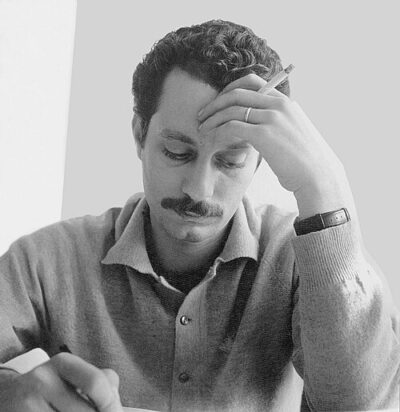
Ghassan Kanafani
Ghassan Kanafani was a Palestinian writer. Born April 9, 1936, in Acre. Died July 8, 1972, in Beirut. Known for Umm Saʻd, Men in the Sun and Return to Haifa. Awards include Lotus Prize for Literature.
Facts
22 facts · 1 confirmed by two sources · 4 cited · 16 from one source · 1 where the sources disagree
What’s different
- Born: we show April 9, 1936 (Sources disagree). Wikipedia says April 8, 1936
Where this comes from
Papalocal keeps its own record. It started from these sources; what each one said is kept here as it was copied, so a change on their side never changes this page by itself. Tap one to read its version.
What Wikidata says · copied November 16, 2026 · revision 2567356150
- Described as
- Palestinian writer (1936–1972)
- Born
- April 9, 1936 · 3 references
- Died
- July 8, 1972 · 4 references
- Born in
- Acre · 1 reference
- Died in
- Beirut · 1 reference
- Cause of death
- truck bombing
- Citizen of
- Mandatory Palestine
- Occupation
- politician; novelist; journalist; writer; literary critic; prose writer · 1 reference; teacher · 1 reference
- Political party
- Popular Front for the Liberation of Palestine · 1 reference; Arab Nationalist Movement
- Known for
- Umm Saʻd; Men in the Sun; Return to Haifa
- Awards
- Lotus Prize for Literature (1975)
- Children
- Fayez Kanafani
- Siblings
- ʻAdnān Kanafānī; Marwān Kanafānī
- Wikipedias with a page
- 51
Wikidata item Q369696 (wikidata.org/wiki/Q369696), public domain (CC0). Copied November 16, 2026.
What Wikipedia says · copied November 16, 2026 · revision 1373497778
Ghassan Fayiz Kanafani (Arabic: غسان فايز كنفاني; 8 April 1936 – 8 July 1972) was a prominent Palestinian author and militant, considered to be a leading novelist of his generation and one of the Arab world's leading writers. Kanafani's works have been translated into more than 17 languages.
Kanafani was born in Acre, then part of Mandatory Palestine, in 1936. During the 1948 Palestine war, his family was forced out of their hometown by Zionist militias. Kanafani later recalled the intense shame he felt when, at the age of 12, he watched the men of his family surrender their weapons to become refugees. The family settled in Damascus, Syria, where he completed his primary education. He then became a teacher for displaced Palestinian children in a refugee camp, where he began writing short stories in order to help his students contextualize their situation. He began studying for an Arabic Literature degree at the University of Damascus in 1952, but before he could complete his degree, he was expelled from the university for his political affiliations with the Movement of Arab Nationalists (MAN), to which he had been recruited by George Habash. He later relocated to Kuwait and then Beirut, Lebanon, where he became immersed in Marxism.
In 1961, he married Anni Høver, a Danish pedagogue and children's rights activist, with whom he had two children. He became an editor and wrote articles for a number of Arab magazines and newspapers. His 1963 novel Men in the Sun received widespread acclaim and, along with A World That Is Not Ours, symbolizes his first period of pessimism, which was later reversed in favor of active struggle in the aftermath of the 1967 Six-Day War. That year, he joined the Popular Front for the Liberation of Palestine (PFLP) and became its spokesman. In 1969, he drafted a PFLP program in which the movement officially adopted Marxism–Leninism, which marked a departure from pan-Arab nationalism towards revolutionary Palestinian struggle.
In 1972, while he was in Beirut, Kanafani and his 17-year-old niece Lamees were killed by a bomb planted in his car by the Mossad, which was suspected to be in response for the PFLP's role in the Lod Airport massacre; however, Kanafani's assassination may have been planned long before. Kanafani had appeared with the massacre's perpetrators in a photograph shortly before, and he defended their tactics before being assassinated.
- Born, in its opening lines
- April 8, 1936
- Died, in its opening lines
- July 8, 1972
From the Wikipedia article “Ghassan Kanafani” (en.wikipedia.org/wiki/Ghassan_Kanafani), by its contributors, under CC BY-SA 4.0 (creativecommons.org/licenses/by-sa/4.0/). Copied November 16, 2026; not changed.
Confirmed Two sources agree. Cited One source, and it names where it got it. One source One source, without a reference of its own. Sources disagree The sources disagree. We show the best-supported value and keep theirs below.
