
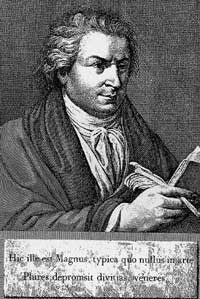
Giambattista Bodoni
Giambattista Bodoni was an Italian typographer, type-designer, compositor, printer and publisher in Parma. Born February 26, 1740, in Saluzzo. Died November 30, 1813, in Parma.
Facts
16 facts · 1 confirmed by two sources · 10 cited · 4 from one source · 1 where the sources disagree
What’s different
- Born: we show February 26, 1740 (Sources disagree). Wikipedia says February 16, 1740
Where this comes from
Papalocal keeps its own record. It started from these sources; what each one said is kept here as it was copied, so a change on their side never changes this page by itself. Tap one to read its version.
What Wikidata says · copied November 17, 2026 · revision 2567367412
- Described as
- Italian typographer, type-designer, compositor, printer and publisher in Parma (1740-1813)
- Other names
- Giovanni Battista Bodoni, Bodoni, Iohannem Baptistam Bodonium, Iohannes Baptista Bodonius, Jean Baptiste Bodoni
- Born
- February 26, 1740 · 6 references
- Died
- November 30, 1813 · 5 references
- Born in
- Saluzzo · 5 references
- Died in
- Parma · 4 references
- Occupation
- type designer; editor; typographer · 2 references; printer · 3 references; printmaker; xylographer · 1 reference; flexographer · 1 reference; publisher · 1 reference
- Member of
- Academy of Sciences of Turin (1801–) · 1 reference
- Spouse
- Margherita Dall'Aglio (1791–) · 2 references
- Father
- Francesco Agostino Bodoni · 1 reference
- Siblings
- Giovanni Domenico Bodoni
- Wikipedias with a page
- 26
Wikidata item Q220768 (wikidata.org/wiki/Q220768), public domain (CC0). Copied November 17, 2026.
What Wikipedia says · copied November 17, 2026 · revision 1356391397
Giambattista Bodoni (, Italian: [dʒambatˈtista boˈdoːni]; 16 February 1740 – 30 November 1813) was an Italian typographer, type-designer, compositor, printer, and publisher in Parma.
He first took the type-designs of Pierre Simon Fournier as his exemplars, but afterwards became an admirer of the more modelled types of John Baskerville; and he and Firmin Didot evolved a style of type called "Modern", in which the letters are cut in such a way as to produce a strong contrast between the thick and thin parts of their body. Bodoni designed many typefaces, each one in a large range of type sizes. He is even more admired as a compositor than as a type designer, as the large range of sizes which he cut enabled him to compose his pages with the greatest possible subtlety of spacing. Like Baskerville, he sets off his texts with wide margins and uses little or no illustrations or decorations.
Bodoni achieved an unprecedented level of technical refinement, allowing him to faithfully reproduce letterforms with very thin "hairlines", standing in sharp contrast to the thicker lines constituting the main stems of the characters. He became known for his designs of pseudoclassical typefaces and highly styled editions, some considered more apt "to be admired for typeface and layout, not to be studied or read". His printing reflected an aesthetic of plain, unadorned style, combined with purity of materials. This style attracted many admirers and imitators, surpassing the popularity of French typographers such as Philippe Grandjean and Pierre Simon Fournier. Bodoni has also had his share of detractors, including William Morris, who felt that his almost mechanical perfection seemed cold and inhumane.
There have been several modern revivals of his typefaces, all called Bodoni. They are often used as display faces.
- Born, in its opening lines
- February 16, 1740
- Died, in its opening lines
- November 30, 1813
From the Wikipedia article “Giambattista Bodoni” (en.wikipedia.org/wiki/Giambattista_Bodoni), by its contributors, under CC BY-SA 4.0 (creativecommons.org/licenses/by-sa/4.0/). Copied November 17, 2026; not changed.
Confirmed Two sources agree. Cited One source, and it names where it got it. One source One source, without a reference of its own. Sources disagree The sources disagree. We show the best-supported value and keep theirs below.
