
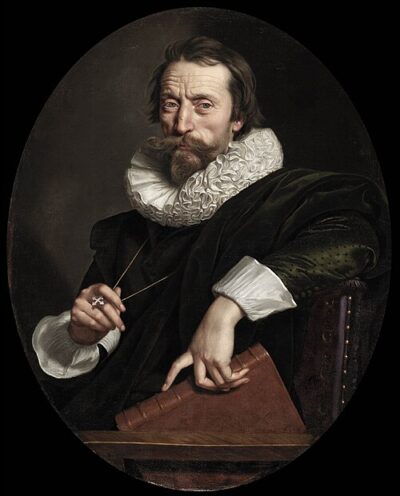
Giambattista Marino
Giambattista Marino was an Italian poet. Born October 14, 1569, in Naples. Died March 25, 1625, in Naples. Known for L'Adone and La strage degli innocenti.
Facts
16 facts · 1 confirmed by two sources · 5 cited · 9 from one source · 1 where the sources disagree
What’s different
- Died: we show March 25, 1625 (Sources disagree). Wikipedia says March 26, 1625
Where this comes from
Papalocal keeps its own record. It started from these sources; what each one said is kept here as it was copied, so a change on their side never changes this page by itself. Tap one to read its version.
What Wikidata says · copied November 16, 2026 · revision 2565085925
- Described as
- Italian poet (1569-1625)
- Other names
- Gian Battista Marino, Giambattista Marini, Giovan Battista Marino
- Born
- October 14, 1569 · 1 reference
- Died
- March 25, 1625 · 10 references
- Born in
- Naples · 2 references
- Died in
- Naples · 2 references
- Citizen of
- Kingdom of Naples
- Occupation
- poet · 2 references; writer · 3 references; playwright · 1 reference
- Member of
- Accademia degli Umoristi; Accademia degli Oziosi
- Genre
- narrative poetry · 1 reference; canzone · 1 reference; sonnet · 1 reference; madrigal · 1 reference
- Known for
- L'Adone; La strage degli innocenti
- Wikipedias with a page
- 46
Wikidata item Q332489 (wikidata.org/wiki/Q332489), public domain (CC0). Copied November 16, 2026.
What Wikipedia says · copied November 16, 2026 · revision 1376786955
Giambattista Marino (also Giovan Battista Marini) (14 October 1569 – 26 March 1625) was an Italian poet who was born in Naples. He is most famous for his epic L'Adone.
The Cambridge History of Italian Literature thought him to be "one of the greatest Italian poets of all time". He is considered the founder of the school of Marinism, later known as Secentismo (17th century) or Marinismo (19th century), characterised by its use of extravagant and excessive conceits. Marino's conception of poetry, which exaggerated the artificiality of Mannerism, was based on an extensive use of antithesis and a whole range of wordplay, on lavish descriptions and a sensuous musicality of the verse, and enjoyed immense success in his time, comparable to that of Petrarch before him.
He was widely imitated in Italy, France (where he was the idol of members of the précieux school, such as Georges Scudéry, and the so-called libertins such as Tristan l'Hermite), Spain (where his greatest admirer was Lope de Vega) and other Catholic countries, including Portugal and Poland, as well as Germany, where his closest follower was Christian Hoffmann von Hoffmannswaldau and Holland where Constantijn Huygens was a great admirer. In England, he was admired by John Milton and translated by Richard Crashaw.
He remained the reference point for Baroque poetry as long as it was in vogue. In the 18th and 19th centuries, while being remembered for historical reasons, he was regarded as the source and exemplar of Baroque "bad taste". With the 20th-century renaissance of interest in similar poetic procedures, his work has been reevaluated: it was closely read by Benedetto Croce and Carlo Calcaterra and has had numerous important interpreters, including Giovanni Pozzi, Marziano Guglielminetti, Marzio Pieri and Alessandro Martini.
- Born, in its opening lines
- October 14, 1569
- Died, in its opening lines
- March 26, 1625
From the Wikipedia article “Giambattista Marino” (en.wikipedia.org/wiki/Giambattista_Marino), by its contributors, under CC BY-SA 4.0 (creativecommons.org/licenses/by-sa/4.0/). Copied November 16, 2026; not changed.
Confirmed Two sources agree. Cited One source, and it names where it got it. One source One source, without a reference of its own. Sources disagree The sources disagree. We show the best-supported value and keep theirs below.
