
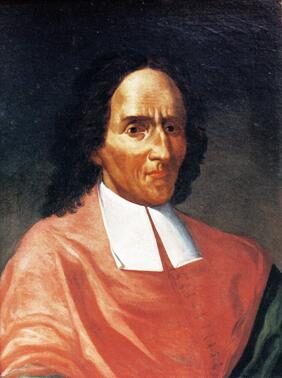
Giambattista Vico
Giambattista Vico was an Italian philosopher, rhetorician, historian and jurist. Born June 23, 1668, in Naples. Died January 23, 1744, in Naples. Known for The New Science, De nostri temporis studiorum ratione and De antiquissima Italorum sapientia. Educated at University of Naples Federico II.
Facts
22 facts · 2 confirmed by two sources · 6 cited · 14 from one source
Where this comes from
Papalocal keeps its own record. It started from these sources; what each one said is kept here as it was copied, so a change on their side never changes this page by itself. Tap one to read its version.
What Wikidata says · copied November 16, 2026 · revision 2568007010
- Described as
- Italian philosopher, rhetorician, historian and jurist
- Other names
- Gianbattista Vico, Giovan Battista Vico, John Baptist Vico, Giovanni Battista Vico
- Born
- June 23, 1668 · 9 references
- Died
- January 23, 1744 · 7 references
- Born in
- Naples · 1 reference
- Died in
- Naples · 1 reference
- Name at birth
- Giovan Battista Vico
- Citizen of
- Kingdom of Naples
- Occupation
- philosopher · 2 references; sociologist; historian · 2 references; collector of fairy tales; jurist · 1 reference; legal scholar · 1 reference
- Worked for
- University of Naples Federico II
- Education
- University of Naples Federico II
- Member of
- Academy of Sciences of Turin
- Known for
- The New Science; De nostri temporis studiorum ratione; De antiquissima Italorum sapientia; De rebus gestis Antonii Caraphaei
- Field
- philosophy
- Spouse
- Teresa Caterina Destito
- Religion
- Catholicism
- Wikipedias with a page
- 79
Wikidata item Q178709 (wikidata.org/wiki/Q178709), public domain (CC0). Copied November 16, 2026.
What Wikipedia says · copied November 16, 2026 · revision 1380251996
Giambattista Vico (born Giovanni Battista Vico ; Italian: [ˈviːko]; 23 June 1668 – 23 January 1744) was an Italian philosopher, rhetorician, historian, and jurist during the Italian Enlightenment. He criticized the expansion and development of modern rationalism, finding Cartesian analysis and other types of reductionism impractical to human life, and he was an apologist for classical antiquity and the Renaissance humanities, in addition to being the first expositor of the fundamentals of social science and of semiotics. He is recognised as one of the first Counter-Enlightenment figures in history.
The Latin aphorism "Verum esse ipsum factum" ("truth is itself something made") coined by Vico is an early instance of constructivist epistemology. He inaugurated the modern field of the philosophy of history, and, although the term philosophy of history is not in his writings, Vico spoke of a "history of philosophy narrated philosophically." Although he was not an historicist, contemporary interest in Vico usually has been motivated by historicists, such as Isaiah Berlin, a philosopher and historian of ideas, and Hayden White, a metahistorian.
Vico's intellectual magnum opus is the book Scienza Nuova or New Science (1725), which attempts a systematic organization of the humanities as a single science that records and explains the historical cycles by which societies rise and fall.
- Born, in its opening lines
- June 23, 1668
- Died, in its opening lines
- January 23, 1744
From the Wikipedia article “Giambattista Vico” (en.wikipedia.org/wiki/Giambattista_Vico), by its contributors, under CC BY-SA 4.0 (creativecommons.org/licenses/by-sa/4.0/). Copied November 16, 2026; not changed.
Confirmed Two sources agree. Cited One source, and it names where it got it. One source One source, without a reference of its own. Sources disagree The sources disagree. We show the best-supported value and keep theirs below.
