
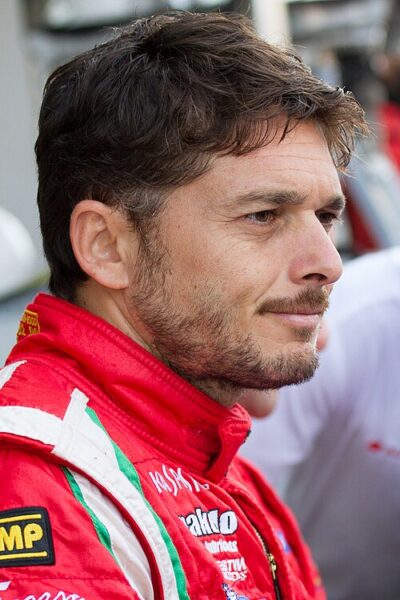
Giancarlo Fisichella is an Italian racecar driver. Born January 14, 1973, in Rome.
Facts
9 facts · 1 confirmed by two sources · 1 cited · 7 from one source
Where this comes from
Papalocal keeps its own record. It started from these sources; what each one said is kept here as it was copied, so a change on their side never changes this page by itself. Tap one to read its version.
What Wikidata says · copied November 16, 2026 · revision 2533567095
- Described as
- Italian racecar driver
- Born
- January 14, 1973
- Born in
- Rome
- Citizen of
- Italy
- Occupation
- racing automobile driver · 1 reference; Formula One driver
- Sport
- auto racing; padel
- Height
- 1.72 m (5 ft 8 in)
- Website
- http://www.giancarlofisichella.com
- Wikipedias with a page
- 55
Wikidata item Q172712 (wikidata.org/wiki/Q172712), public domain (CC0). Copied November 16, 2026.
What Wikipedia says · copied November 16, 2026 · revision 1385778203
Giancarlo "Giano" Fisichella (Italian pronunciation: [dʒaŋˈkarlo fiziˈkɛlla]; born 14 January 1973), nicknamed Fisico and Fisi, is an Italian racing driver and motorsport executive who competed in Formula One from 1996 to 2009. Fisichella won three Formula One Grands Prix across 14 seasons.
Born and raised in Rome, Fisichella is a member of the noble Fisichella family of Sicily. After starting his career in kart racing, he progressed to Italian Formula Three in 1992, winning the title in 1994 with RC Motorsport, as well as the Monaco F3 Grand Prix. Following a season in the Deutsche Tourenwagen Meisterschaft, Fisichella graduated to Formula One with Minardi in 1996, debuting at the Australian Grand Prix. He moved to Jordan for 1997, achieving his maiden podium finishes at the Canadian and Belgian Grands Prix. He joined Benetton in 1998 with multiple further podiums, as well as his maiden pole position at the Austrian Grand Prix. Several podiums followed across his remaining three seasons at Enstone: one in 1999, three in 2000—where he finished sixth in the World Drivers' Championship—and one in 2001.
Fisichella returned to Jordan in 2002, where he claimed his maiden win at the wet-weather Brazilian Grand Prix the following year; his victory was declared after five days of deliberation and court proceedings due to a timekeeping error classifying him second. He partnered Felipe Massa at Sauber for his 2004 campaign, scoring several points finishes. His return to Enstone with Renault in 2005 alongside Fernando Alonso was headlined by his debut victory from pole in Australia, claiming multiple further podiums as he finished fifth overall. He achieved a career-best fourth in the World Drivers' Championship in 2006, winning the Malaysian Grand Prix from pole as he helped Renault win back-to-back World Constructors' Championships. After a winless 2007 campaign, Fisichella joined Force India for 2008 and 2009, finishing second from pole at the latter Belgian Grand Prix; he replaced an injured Massa at Ferrari for the final five rounds and remained their reserve driver through 2010. Fisichella departed Formula One with three victories, four pole positions, two fastest laps, and 19 podium finishes.
Following his departure from Formula One, Fisichella moved into sportscar racing with AF Corse, winning the Le Mans Series in 2011 and the FIA World Endurance Championship and 24 Hours of Le Mans in 2012 in the GTE class. He again took a class victory at Le Mans in 2014, when he moved to the IMSA SportsCar Championship with Risi Competizione. He later returned to WEC from 2018 to 2022, after which he shifted to Italian GT3. Beyond driving, he founded the eponymous Fisichella Motor Sport in 2005, managing the team in the GP2 Series from 2006 to 2009.
- Born, in its opening lines
- January 14, 1973
From the Wikipedia article “Giancarlo Fisichella” (en.wikipedia.org/wiki/Giancarlo_Fisichella), by its contributors, under CC BY-SA 4.0 (creativecommons.org/licenses/by-sa/4.0/). Copied November 16, 2026; not changed.
Confirmed Two sources agree. Cited One source, and it names where it got it. One source One source, without a reference of its own. Sources disagree The sources disagree. We show the best-supported value and keep theirs below.
