
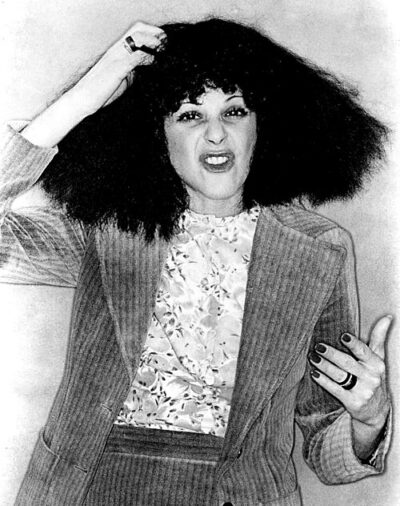
Gilda Radner
Gilda Radner was an American actress and comedian. Born June 28, 1946, in Detroit. Died May 20, 1989, in Los Angeles. Educated at University of Michigan and Mumford High School. Awards include Primetime Emmy Award for Individual Performance in a Variety or Music Program, Michigan Women's Hall of Fame and CableACE Award.
Facts
26 facts · 2 confirmed by two sources · 2 cited · 22 from one source
Where this comes from
Papalocal keeps its own record. It started from these sources; what each one said is kept here as it was copied, so a change on their side never changes this page by itself. Tap one to read its version.
What Wikidata says · copied November 15, 2026 · revision 2565753719
- Described as
- American actress and comedian (1946–1989)
- Other names
- Gilda Susan Radner
- Born
- June 28, 1946 · 8 references
- Died
- May 20, 1989 · 7 references
- Born in
- Detroit
- Died in
- Los Angeles
- Buried in
- Connecticut
- Cause of death
- ovarian cancer
- Citizen of
- United States
- Occupation
- comedian; autobiographer; stage actor; television actor; film actor · 1 reference; screenwriter · 1 reference; singer · 1 reference; voice actor · 1 reference
- Education
- University of Michigan; Mumford High School · 1 reference; University Liggett School · 1 reference
- Instrument
- voice
- Awards
- Primetime Emmy Award for Individual Performance in a Variety or Music Program; Michigan Women's Hall of Fame (1992) · 1 reference; CableACE Award · 1 reference; star on Hollywood Walk of Fame · 1 reference; Grammy Award for Best Audio Book, Narration & Storytelling Recording
- Spouse
- Gene Wilder (1984–1989); G. E. Smith (1980–1982)
- Wikipedias with a page
- 37
Wikidata item Q266808 (wikidata.org/wiki/Q266808), public domain (CC0). Copied November 15, 2026.
What Wikipedia says · copied November 15, 2026 · revision 1385120269
Gilda Susan Radner (June 28, 1946 – May 20, 1989) was an American actress and comedian.
Radner was one of the seven original cast members of the NBC sketch comedy series Saturday Night Live from its inception in 1975 until her departure in 1980. In her sketches on SNL, she played various original characters on the show's Weekend Update segment, such as the elderly, hard-of-hearing Emily Litella and the advice specialist Roseanne Roseannadanna, who rarely offered advice but often provided disgusting, off-topic stories. Radner won an Emmy Award for her performances on the show in 1978. She also portrayed those characters, among others, in her one-woman show Gilda, Live on Broadway in 1979 and later on film in 1980.
After leaving Saturday Night Live, Radner appeared in various films, including three with her future husband Gene Wilder, with whom she first appeared in 1982's Hanky Panky. She also worked on stage, appearing in the Broadway play Lunch Hour with Sam Waterston in 1980. She also continued to work on network and cable television, making appearances on Lorne Michaels' The New Show and It's Garry Shandling's Show.
After nearly a year of misdiagnoses, Radner was diagnosed with ovarian cancer in 1986 and died from the disease in 1989. Shortly before her death, she published her autobiography, It's Always Something, which dealt frankly with her life, work, and personal struggles, including her struggles with the illness. Her widower, Gene Wilder, carried out her wish that information about her illness would be used to help other people living with cancer, founding—and inspiring the founding of—organizations that emphasize early diagnosis, attention to hereditary factors, and support for cancer patients.
Posthumously, Radner won a Grammy Award in 1990, was inducted into the Michigan Women's Hall of Fame in 1992, and received a star on the Hollywood Walk of Fame in 2003. Other comedians have cited Radner as an influence on their work.
- Born, in its opening lines
- June 28, 1946
- Died, in its opening lines
- May 20, 1989
From the Wikipedia article “Gilda Radner” (en.wikipedia.org/wiki/Gilda_Radner), by its contributors, under CC BY-SA 4.0 (creativecommons.org/licenses/by-sa/4.0/). Copied November 15, 2026; not changed.
Confirmed Two sources agree. Cited One source, and it names where it got it. One source One source, without a reference of its own. Sources disagree The sources disagree. We show the best-supported value and keep theirs below.
