
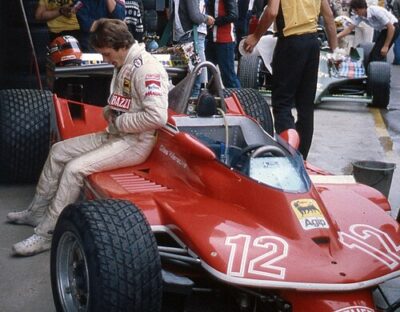
Gilles Villeneuve
Gilles Villeneuve was a Canadian racing driver. Born January 18, 1950, in Saint-Jean-sur-Richelieu. Died May 8, 1982, in Leuven. Teams include Scuderia Ferrari. Awards include Quebec Sports Hall of Fame and Canada's Sports Hall of Fame.
Facts
16 facts · 2 confirmed by two sources · 1 cited · 13 from one source
Where this comes from
Papalocal keeps its own record. It started from these sources; what each one said is kept here as it was copied, so a change on their side never changes this page by itself. Tap one to read its version.
What Wikidata says · copied November 13, 2026 · revision 2553824548
- Described as
- Canadian racing driver (1950–1982)
- Other names
- Joseph Gilles Henri Villeneuve
- Born
- January 18, 1950 · 4 references
- Died
- May 8, 1982 · 4 references
- Born in
- Saint-Jean-sur-Richelieu
- Died in
- Leuven
- Buried in
- Berthierville Catholic Cemetery · 1 reference
- Cause of death
- traffic collision
- Citizen of
- Canada
- Occupation
- Formula One driver; motorcycle racer
- Teams
- Scuderia Ferrari
- Sport
- auto racing; motorcycle sport
- Awards
- Quebec Sports Hall of Fame; Canada's Sports Hall of Fame
- Children
- Jacques Villeneuve
- Siblings
- Jacques Villeneuve
- Wikipedias with a page
- 47
Wikidata item Q172845 (wikidata.org/wiki/Q172845), public domain (CC0). Copied November 13, 2026.
What Wikipedia says · copied November 13, 2026 · revision 1385507124
Joseph Gilles Henri Villeneuve (French pronunciation: [ʒil vil.nœv]; 18 January 1950 – 8 May 1982) was a Canadian racing driver, who competed in Formula One from 1977 to 1982. Villeneuve was runner-up in the Formula One World Drivers' Championship in 1979 with Ferrari, and won six Grands Prix across six seasons.
A racing enthusiast from an early age, Villeneuve started his career in snowmobile racing across his native province of Quebec. He soon progressed to open-wheel racing, winning the regional Formula Ford championship in 1973 before graduating to Formula Atlantic, where he won two Canadian Championships in 1976 and 1977, and the American Championship in 1976. Villeneuve made his Formula One debut with McLaren at the 1977 British Grand Prix, impressing Enzo Ferrari, who signed him with Ferrari for 1978. He made an early debut for the team at the Canadian Grand Prix after the departure of World Champion Niki Lauda, and was involved in a collision with Ronnie Peterson which killed two bystanders at the season-ending Japanese Grand Prix. Amidst struggles with Michelin's radial tyres the following year, Villeneuve took his maiden podium in Austria before winning his home Grand Prix in Canada. He won three races in 1979, ultimately finishing the championship runner-up to teammate Jody Scheckter by four points. Villeneuve earned widespread acclaim for his performances, including his duel with René Arnoux at the French Grand Prix. After a winless season for Ferrari with the 312T5 in 1980, Villeneuve took back-to-back wins at the Monaco and Spanish Grands Prix in 1981, earning further acclaim for his defensive tactics at the latter.
During qualifying for the 1982 Belgian Grand Prix at Zolder, Villeneuve died as the result of a collision with Jochen Mass. He achieved six wins, two pole positions, eight fastest laps, and 13 podiums in Formula One. At the time of his death, Villeneuve was widely popular in the motorsport community and has since become an iconic figure in the history of the sport. The Circuit Île Notre-Dame in Montreal—home of the Canadian Grand Prix since his 1978 victory—was renamed the Circuit Gilles Villeneuve upon his death. His son, Jacques, became the first World Drivers' Champion from Canada in 1997. Alongside Jacques, Villeneuve is an inductee of the Canadian Motorsport Hall of Fame and Canada's Sports Hall of Fame.
- Born, in its opening lines
- January 18, 1950
- Died, in its opening lines
- May 8, 1982
From the Wikipedia article “Gilles Villeneuve” (en.wikipedia.org/wiki/Gilles_Villeneuve), by its contributors, under CC BY-SA 4.0 (creativecommons.org/licenses/by-sa/4.0/). Copied November 13, 2026; not changed.
Confirmed Two sources agree. Cited One source, and it names where it got it. One source One source, without a reference of its own. Sources disagree The sources disagree. We show the best-supported value and keep theirs below.
