
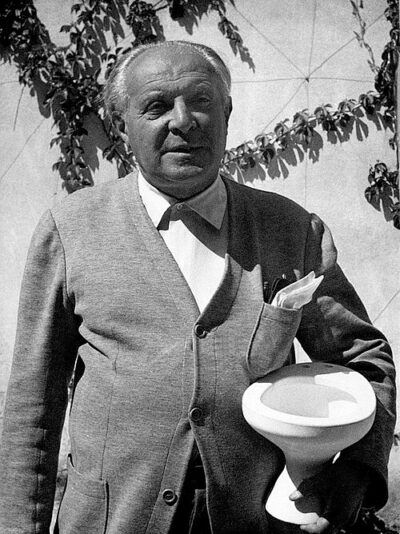
Gio Ponti
Gio Ponti was an Italian architect. Born November 18, 1891, in Milan. Died September 16, 1979, in Milan. Known for Torre Branca, Pirelli Tower and Villa Ponti Bellavista. Educated at Polytechnic University of Milan. Awards include Royal Order of Vasa.
Facts
27 facts · 2 confirmed by two sources · 15 cited · 10 from one source
Where this comes from
Papalocal keeps its own record. It started from these sources; what each one said is kept here as it was copied, so a change on their side never changes this page by itself. Tap one to read its version.
What Wikidata says · copied November 17, 2026 · revision 2557897687
- Described as
- Italian architect (1891–1979)
- Other names
- Giovanni Ponti, Giò Ponti
- Born
- November 18, 1891 · 8 references
- Died
- September 16, 1979 · 6 references
- Born in
- Milan · 3 references
- Died in
- Milan · 1 reference
- Buried in
- monumental cemetery of Milan
- Citizen of
- Kingdom of Italy (–1946); Italy (1946–) · 2 references
- Occupation
- architect · 5 references; designer · 3 references; university teacher; scenographer · 1 reference; painter · 1 reference; industrial designer · 2 references; writer · 1 reference; interior designer · 1 reference
- Worked for
- Polytechnic University of Milan; School of Architecture, Urbanism and Design of the University of São Paulo (1952) · 1 reference
- Education
- Polytechnic University of Milan
- Known for
- Torre Branca; Pirelli Tower; Villa Ponti Bellavista
- Awards
- Royal Order of Vasa · 1 reference
- Field
- architecture · 1 reference; design · 1 reference; scenography · 1 reference; painting · 1 reference
- Website
- https://www.gioponti.org
- Wikipedias with a page
- 26
Wikidata item Q435810 (wikidata.org/wiki/Q435810), public domain (CC0). Copied November 17, 2026.
What Wikipedia says · copied November 17, 2026 · revision 1372566618
Giovanni "Gio" Ponti (Italian pronunciation: [ˌdʒo pˈponti]; 18 November 1891 – 16 September 1979) was an Italian architect, industrial designer, furniture designer, artist, teacher, writer and publisher.
During his career, which spanned six decades, Ponti built more than a hundred buildings in Italy and in the rest of the world. He designed a considerable number of decorative art and design objects as well as furniture. Thanks to the magazine Domus, which he founded in 1928 and directed almost all his life, and thanks to his active participation in exhibitions such as the Milan Triennial, he was also an enthusiastic advocate of an Italian-style art of living and a major player in the renewal of Italian design after the Second World War. From 1936 to 1961, he taught at the Milan Polytechnic School and trained several generations of designers. Ponti also contributed to the creation in 1954 of one of the most important design awards: the Compasso d'Oro, and was himself awarded the prize in 1956. Ponti died on 16 September 1979.
His most famous works are the Pirelli Tower, built from 1956 to 1960 in Milan in collaboration with the engineer Pier Luigi Nervi, the Villa Planchart in Caracas and the Superleggera chair, produced by Cassina in 1957.
- Born, in its opening lines
- November 18, 1891
- Died, in its opening lines
- September 16, 1979
From the Wikipedia article “Gio Ponti” (en.wikipedia.org/wiki/Gio_Ponti), by its contributors, under CC BY-SA 4.0 (creativecommons.org/licenses/by-sa/4.0/). Copied November 17, 2026; not changed.
Confirmed Two sources agree. Cited One source, and it names where it got it. One source One source, without a reference of its own. Sources disagree The sources disagree. We show the best-supported value and keep theirs below.
