
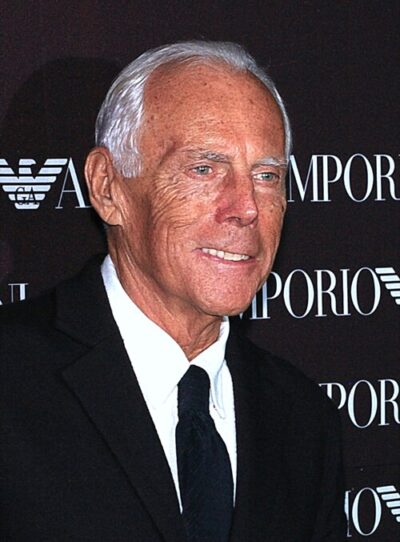
Giorgio Armani
Giorgio Armani was an Italian fashion designer. Born July 11, 1934, in Piacenza. Died September 4, 2025, in Milan. Educated at University of Milan. Awards include Officer of the Legion of Honour, CFDA Lifetime Achievement Award and Knight Grand Cross of the Order of Merit of the Italian Republic.
Facts
20 facts · 2 confirmed by two sources · 10 cited · 8 from one source
Where this comes from
Papalocal keeps its own record. It started from these sources; what each one said is kept here as it was copied, so a change on their side never changes this page by itself. Tap one to read its version.
What Wikidata says · copied November 16, 2026 · revision 2562797457
- Described as
- Italian fashion designer (1934–2025)
- Born
- July 11, 1934 · 8 references
- Died
- September 4, 2025 · 4 references
- Born in
- Piacenza · 2 references
- Died in
- Milan · 2 references
- Citizen of
- Italy
- Occupation
- entrepreneur; fashion designer · 2 references; autobiographer · 1 reference
- Worked for
- Giorgio Armani
- Education
- University of Milan · 1 reference
- Awards
- Officer of the Legion of Honour (2008); CFDA Lifetime Achievement Award (1987) · 1 reference; Knight Grand Cross of the Order of Merit of the Italian Republic (2021) · 1 reference; Compasso d'Oro (2014) · 1 reference; Neiman Marcus Fashion Award (1979) · 1 reference; honorary degree (2023) · 1 reference; Grand Officer of the Order of Merit of the Italian Republic (1986); Commander of the Order of Merit of the Italian Republic (1985)
- Field
- fashion design
- Siblings
- Rosanna Armani
- Wikipedias with a page
- 79
Wikidata item Q157054 (wikidata.org/wiki/Q157054), public domain (CC0). Copied November 16, 2026.
What Wikipedia says · copied November 16, 2026 · revision 1385411565
Giorgio Armani (Italian: [ˈdʒordʒo arˈmaːni]; 11 July 1934 – 4 September 2025) was an Italian fashion designer and founder of the Armani luxury fashion house. Widely regarded as among the most influential designers in contemporary fashion, Armani initially gained recognition for his work with fashion house Cerruti 1881, before founding his own label in 1975. He became known for minimalist, deconstructed silhouettes—especially his jackets and suits—which are said to have redefined masculine and feminine elegance in a contemporary form. Armani also played a pivotal role in shaping celebrity style, particularly red-carpet fashion. By the early 2000s, he was recognized as the most successful Italian designer, with his brand expanding into music, sport, and luxury hotels.
Born in Piacenza, Armani grew up during World War II in modest circumstances and initially pursued medical studies at the University of Milan before leaving to serve in the Italian Army. After his military service, Armani began his career in fashion as a window dresser and sales clerk at La Rinascente in Milan, later designing menswear for Nino Cerruti while freelancing for multiple manufacturers. In 1973, he partnered with Sergio Galeotti to open a design office and in 1975 they founded Giorgio Armani S.p.A., launching men's and women's ready-to-wear collections. Armani expanded his brand globally, introducing several lines including Emporio Armani, Armani Junior and AX Armani Exchange, while also establishing a presence in cosmetics, perfumes and home furnishings. His work in costume design for over 100 films, notably American Gigolo (1980), helped cement his international reputation.
Beyond fashion, Armani ventured into hotels, sports and music, including the Armani Hotel in Dubai, designing uniforms for Olympic and professional sports teams and curating Emporio Armani Caffè music compilations. He was an advocate for ethical practices, including banning underweight models in 2007 and promoting sustainable fashion initiatives. Armani maintained a private personal life, including a long-term partnership with Galeotti until the latter's death in 1985.
- Born, in its opening lines
- July 11, 1934
- Died, in its opening lines
- September 4, 2025
From the Wikipedia article “Giorgio Armani” (en.wikipedia.org/wiki/Giorgio_Armani), by its contributors, under CC BY-SA 4.0 (creativecommons.org/licenses/by-sa/4.0/). Copied November 16, 2026; not changed.
Confirmed Two sources agree. Cited One source, and it names where it got it. One source One source, without a reference of its own. Sources disagree The sources disagree. We show the best-supported value and keep theirs below.
