
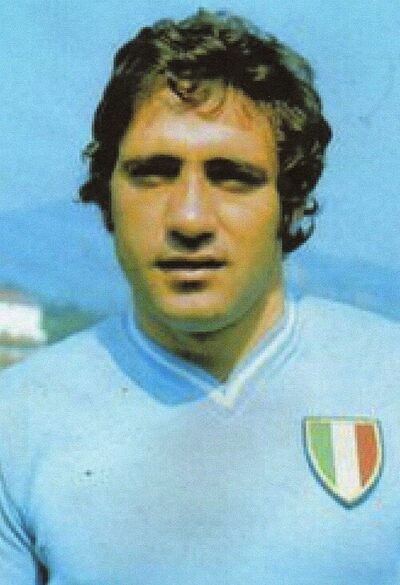
Giorgio Chinaglia
Giorgio Chinaglia was an Italian footballer. Born January 24, 1947, in Carrara. Died April 1, 2012, in Naples. Teams include Swansea City A.F.C. (1964–1966), SS Lazio (1969–1976) and S.S.D. Puteolana 1902.
Facts
20 facts · 2 confirmed by two sources · 7 cited · 11 from one source
Where this comes from
Papalocal keeps its own record. It started from these sources; what each one said is kept here as it was copied, so a change on their side never changes this page by itself. Tap one to read its version.
What Wikidata says · copied November 16, 2026 · revision 2555126790
- Described as
- Italian footballer (1947-2012)
- Born
- January 24, 1947 · 4 references
- Died
- April 1, 2012 · 4 references
- Born in
- Carrara · 1 reference
- Died in
- Naples · 1 reference
- Buried in
- Cimitero Flaminio
- Cause of death
- myocardial infarction · 1 reference
- Citizen of
- Italy
- Occupation
- association football player (–1991) · 1 reference; manager · 1 reference
- Teams
- Swansea City A.F.C. (1964–1966); SS Lazio (1969–1976); S.S.D. Puteolana 1902; S.S.D. Massese (1966–1967); S.S.D. Puteolana 1902 Internapoli (1967–1969); New York Cosmos (1976–1983); Italy men's national association football team (1972–1975); Internapoli F.C. (1967–1969)
- Sport
- association football · 1 reference
- Field
- sport management · 1 reference
- Height
- 1.86 m (6 ft 1 in)
- Wikipedias with a page
- 36
Wikidata item Q363377 (wikidata.org/wiki/Q363377), public domain (CC0). Copied November 16, 2026.
What Wikipedia says · copied November 16, 2026 · revision 1381394401
Giorgio Chinaglia (Italian pronunciation: [ˈdʒordʒo kiˈnaʎʎa]; 24 January 1947 – 1 April 2012) was an Italian footballer who played as a striker. He grew up and played his early football in Cardiff, Wales, and began his career with Swansea Town in 1964. He later returned to Italy to play for Massese, Internapoli and Lazio in 1969. Chinaglia led Lazio to the club's first league championship in the 1973–74 season, during which he was also the league's leading scorer. He played international football for Italy, making 14 appearances and scoring 4 goals between 1972 and 1975, including two appearances at the 1974 FIFA World Cup. Chinaglia was the first player in Italian football history to be called up internationally from the second division.
In 1976, Chinaglia left Lazio to sign with the New York Cosmos of the North American Soccer League. With the Cosmos team that also featured Pelé and Franz Beckenbauer, Chinaglia won four league titles and retired in 1983 as the NASL's all-time leading goal scorer with 193 goals. In 1980, Chinaglia scored a record 50 goals in regular- and post-season play, plus another 26 in friendly matches. In all matches played, including friendly, exhibition and pre-season games, Chinaglia scored 734 goals, giving him a lifetime average of a goal a game.
In 2000, Chinaglia was inducted into the National Soccer Hall of Fame in the United States and was named the greatest player in Lazio's history during the club's centenary celebrations; with 29 goals, he is also the highest-scoring Lazio player in international competitions. A prolific goalscorer, some sources state that he is the highest scoring Italian player in all professional competitions, with 398 goals, ahead of Silvio Piola, although this claim is also disputed, as the NASL did not abide to certain FIFA regulations at the time. He is also the Italian player with the best goalscoring ratio in domestic championships, with 319 goals scored in 429 league matches played across both Italy and the United States.
Chinaglia was given the nickname "Long John", a reference to Chinaglia's physical style of play, as well as his resemblance to the similarly large Welsh footballing legend John Charles who also played in Italy and Wales.
- Born, in its opening lines
- January 24, 1947
- Died, in its opening lines
- April 1, 2012
From the Wikipedia article “Giorgio Chinaglia” (en.wikipedia.org/wiki/Giorgio_Chinaglia), by its contributors, under CC BY-SA 4.0 (creativecommons.org/licenses/by-sa/4.0/). Copied November 16, 2026; not changed.
Confirmed Two sources agree. Cited One source, and it names where it got it. One source One source, without a reference of its own. Sources disagree The sources disagree. We show the best-supported value and keep theirs below.
