
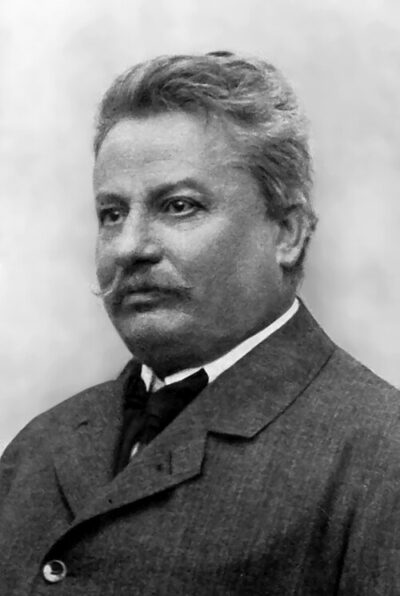
Giovanni Pascoli
Giovanni Pascoli was an Italian poet and classical scholar. Born December 31, 1855, in San Mauro Pascoli. Died April 6, 1912, in Bologna. Educated at University of Bologna.
Facts
19 facts · 2 confirmed by two sources · 5 cited · 12 from one source
Where this comes from
Papalocal keeps its own record. It started from these sources; what each one said is kept here as it was copied, so a change on their side never changes this page by itself. Tap one to read its version.
What Wikidata says · copied November 16, 2026 · revision 2565595730
- Described as
- Italian poet and classical scholar (1855–1912)
- Other names
- Giovanni Placido Agostino Pascoli
- Born
- December 31, 1855 · 9 references
- Died
- April 6, 1912 · 9 references
- Born in
- San Mauro Pascoli · 4 references
- Died in
- Bologna · 4 references
- Buried in
- Barga
- Cause of death
- liver cancer
- Name at birth
- Giovanni Agostino Placido Pascoli
- Citizen of
- Kingdom of Italy (1861–) · 1 reference
- Occupation
- poet · 3 references; translator; writer · 2 references; literary critic · 1 reference
- Worked for
- University of Messina; University of Pisa; University of Bologna
- Education
- University of Bologna
- Father
- Ruggero Pascoli
- Siblings
- Maria Pascoli
- Religion
- atheism
- Wikipedias with a page
- 48
Wikidata item Q375998 (wikidata.org/wiki/Q375998), public domain (CC0). Copied November 16, 2026.
What Wikipedia says · copied November 16, 2026 · revision 1385567847
Giovanni Placido Agostino Pascoli (Italian: [dʒoˈvanni ˈpaskoli]; 31 December 1855 – 6 April 1912) was an Italian poet, classical scholar and an emblematic figure of Italian literature in the late nineteenth century. Alongside Gabriele D'Annunzio, he was one of the greatest Italian decadent poets.
The first publication of "Il Fanciullino" in 1897 reveals an intimate and introspective understanding of poetic sentiment. It emphasizes the importance of the particular and the everyday, while also evoking a childlike, almost primal dimension. According to Pascoli, only the poet can articulate the 'childishness' inherent in everyone. This notion enables him to assume the somewhat anachronistic role of a poet-vate and to reaffirm poetry's moral (particularly its consolatory) and civic value.
Although he did not actively participate in any literary movement of the time nor show any particular inclination towards contemporary European poetry (unlike Gabriele D'Annunzio), he manifested predominantly spiritualistic and symbolistic tendencies in his production, typical of the decadentist culture of the end of the century, marked by the progressive fading away of positivism.
Overall, his work is characterized by a constant tension between the classical tradition inherited from his teacher, Giosuè Carducci, and emerging decadent themes. Understanding the true meaning of his most significant works is challenging without considering the painful and tormented biographical and psychological elements he obsessively restructured throughout his life, forming the foundational semantic system of his poetic and artistic world.
- Born, in its opening lines
- December 31, 1855
- Died, in its opening lines
- April 6, 1912
From the Wikipedia article “Giovanni Pascoli” (en.wikipedia.org/wiki/Giovanni_Pascoli), by its contributors, under CC BY-SA 4.0 (creativecommons.org/licenses/by-sa/4.0/). Copied November 16, 2026; not changed.
Confirmed Two sources agree. Cited One source, and it names where it got it. One source One source, without a reference of its own. Sources disagree The sources disagree. We show the best-supported value and keep theirs below.
