
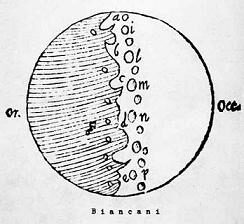
Giuseppe Biancani
Giuseppe Biancani was an Italian mathematician and selenographer. Born March 8, 1566, in Bologna. Died June 7, 1624, in Parma. Educated at Roman College.
Facts
14 facts · 2 confirmed by two sources · 11 cited · 1 from one source
Where this comes from
Papalocal keeps its own record. It started from these sources; what each one said is kept here as it was copied, so a change on their side never changes this page by itself. Tap one to read its version.
What Wikidata says · copied November 18, 2026 · revision 2564349154
- Described as
- Italian mathematician and selenographer
- Born
- March 8, 1566 · 1 reference
- Died
- June 7, 1624 · 2 references
- Born in
- Bologna · 1 reference
- Died in
- Parma · 1 reference
- Occupation
- astronomer · 1 reference; mathematician · 1 reference; university teacher · 1 reference
- Education
- Roman College (1592–1596) · 2 references
- Field
- astronomy · 1 reference; mathematics · 1 reference; education · 1 reference
- Religion
- Catholicism
- Lived in
- Padua (1596–1606) · 1 reference; Parma (1606–1624) · 1 reference
- Wikipedias with a page
- 21
Wikidata item Q501774 (wikidata.org/wiki/Q501774), public domain (CC0). Copied November 18, 2026.
What Wikipedia says · copied November 18, 2026 · revision 1379621593
Giuseppe Biancani (Latin: Josephus Blancanus; 8 March 1566 – 7 June 1624) was an Italian Jesuit astronomer, mathematician, and selenographer, after whom the crater Blancanus on the Moon is named. Biancani was one of the most able and respected Catholic astronomers of his day, and his main work, Sphaera Mundi, was republished at least four times in the seventeenth century, 1620, 1630, 1635, and 1653.
- Born, in its opening lines
- March 8, 1566
- Died, in its opening lines
- June 7, 1624
From the Wikipedia article “Giuseppe Biancani” (en.wikipedia.org/wiki/Giuseppe_Biancani), by its contributors, under CC BY-SA 4.0 (creativecommons.org/licenses/by-sa/4.0/). Copied November 18, 2026; not changed.
Confirmed Two sources agree. Cited One source, and it names where it got it. One source One source, without a reference of its own. Sources disagree The sources disagree. We show the best-supported value and keep theirs below.
