
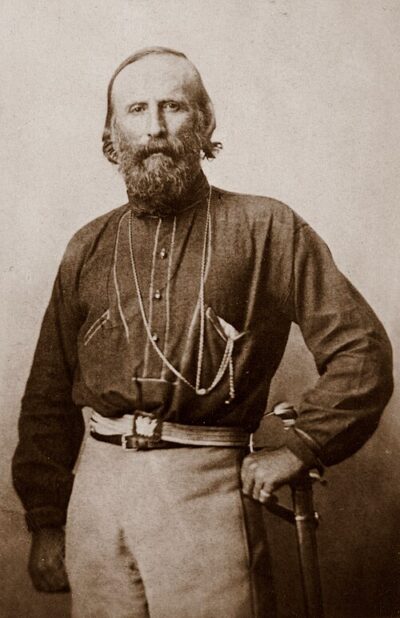
Giuseppe Garibaldi
Giuseppe Garibaldi was an Italian general, patriot and republican. Born July 4, 1807, in Nice. Died June 2, 1882, in Caprera. Positions held include member of the National Assembly (1871), member of the Chamber of Deputies of the Kingdom of Italy (2 times) (1860–1882) and member of the Chamber of Deputies of the Kingdom of Sardinia. Known for Unification of Italy. Awards include Grand Officer of the Military Order of Italy, Gold Medal of Military Valour and Commemoration Medal for the thousand of Marsala.
Facts
47 facts · 2 confirmed by two sources · 9 cited · 36 from one source
Where this comes from
Papalocal keeps its own record. It started from these sources; what each one said is kept here as it was copied, so a change on their side never changes this page by itself. Tap one to read its version.
What Wikidata says · copied November 16, 2026 · revision 2568442500
- Described as
- Italian general, patriot and republican (1807–1882)
- Other names
- Joseph-Marie Garibaldi, Garibaldi, Giuseppe Maria Garibaldi
- Born
- July 4, 1807 · 15 references
- Died
- June 2, 1882 · 16 references
- Born in
- Nice · 4 references
- Died in
- Caprera · 2 references
- Buried in
- Caprera · 1 reference
- Citizen of
- Riograndense Republic; Kingdom of Italy (1861–); France; Kingdom of Sardinia
- Occupation
- politician · 2 references; writer; autobiographer; resistance fighter; military personnel · 1 reference; mercenary · 1 reference; freedom fighter · 1 reference
- Positions held
- member of the National Assembly (1871); member of the Chamber of Deputies of the Kingdom of Italy (2 times) (1860–1882); member of the Chamber of Deputies of the Kingdom of Sardinia
- Political party
- Historical Far Left (1877–1882) · 1 reference; Historical Left (1867–1877); Action Party (1848–1867); Young Italy (1831–1848)
- Known for
- Unification of Italy · 1 reference
- Awards
- Grand Officer of the Military Order of Italy; Gold Medal of Military Valour; Commemoration Medal for the thousand of Marsala; Shield of San Antonio (1846) · 1 reference
- Spouse
- Anita Garibaldi (1842–1849); Giuseppina Raimondi (1860–1876); Francesca Armosino (1880–1882)
- Children
- Ricciotti Garibaldi; Rosa Garibaldi; Teresa Garibaldi; Clelia Garibaldi; Manlio Garibaldi; Rosita Garibaldi; Anita Garibaldi; Menotti Garibaldi · 1 reference
- Father
- Domenico Garibaldi
- Religion
- Catholicism · 1 reference
- Military branch
- Royal Sardinian Army; Royal Italian Army (–1871); privateer · 1 reference
- Military rank
- admiral; major general · 1 reference; general · 1 reference
- Wikipedias with a page
- 134
Wikidata item Q539 (wikidata.org/wiki/Q539), public domain (CC0). Copied November 16, 2026.
What Wikipedia says · copied November 16, 2026 · revision 1385185716
Giuseppe Maria Garibaldi (Italian: [dʒuˈzɛppe ɡariˈbaldi] ; 4 July 1807 – 2 June 1882) was an Italian general, revolutionary and republican. He contributed to the unification of Italy (Risorgimento) and the creation of the Kingdom of Italy. He is considered to be one of Italy's "fathers of the fatherland", along with Camillo Benso di Cavour, King Victor Emmanuel II and Giuseppe Mazzini. Garibaldi is also known as the "Hero of the Two Worlds" because of his military enterprises in South America and Europe.
Garibaldi was a follower of the Italian nationalist Mazzini and embraced the republican nationalism of the Young Italy movement. He became a supporter of Italian unification under a democratic republican government. However, breaking with Mazzini, he pragmatically allied himself with the monarchist Cavour and the Kingdom of Sardinia in the struggle for independence, subordinating his republican ideals to his nationalist ones until Italy was unified. After participating in an uprising in Piedmont, he was sentenced to death, but escaped and sailed to South America, where he spent 14 years in exile, during which he took part in several wars and learned the art of guerrilla warfare. In 1835 he joined the rebels known as the Ragamuffins (farrapos), in the Ragamuffin War in Brazil, and took up their cause of establishing the Riograndense Republic and later the Catarinense Republic. Garibaldi also became involved in the Uruguayan Civil War, raising an Italian force known as Redshirts, and is still celebrated as an important contributor to Uruguay's reconstitution.
In 1848, Garibaldi returned to Italy. He commanded and fought in military campaigns that eventually led to the Italian unification. The provisional government of Milan made him a general and the Minister of War promoted him to General of the Roman Republic in 1849. When the war of independence broke out in April 1859, Garibaldi led his Hunters of the Alps in the capture of major cities in Lombardy, including Varese and Como, until he reached the frontier of South Tyrol; the war ended with the acquisition of Lombardy. The following year, 1860, he led the Expedition of the Thousand on behalf of, and with the consent of, Victor Emmanuel II, King of Sardinia. The expedition was a success and concluded with the annexation of Sicily, Southern Italy, Marche and Umbria to the Kingdom of Sardinia before the creation of a unified Kingdom of Italy on 17 March 1861. His last military campaign took place during the Franco-Prussian War as commander of the Army of the Vosges.
Garibaldi became an international figurehead for national independence and republican ideals, and is considered by twentieth-century historiography and popular culture as Italy's greatest national hero. He was showered with admiration and praise by many contemporary intellectuals and political figures, including Abraham Lincoln, William Brown, Francesco de Sanctis, Victor Hugo, Alexandre Dumas, Malwida von Meysenbug, George Sand, Charles Dickens, and Friedrich Engels. Garibaldi also inspired later figures like Jawaharlal Nehru and Che Guevara. Historian A. J. P. Taylor called him "the only wholly admirable figure in modern history". The volunteers who followed Garibaldi during his campaigns were known as the Garibaldini or Redshirts, after the color of the shirts that they wore in lieu of a uniform.
- Born, in its opening lines
- July 4, 1807
- Died, in its opening lines
- June 2, 1882
From the Wikipedia article “Giuseppe Garibaldi” (en.wikipedia.org/wiki/Giuseppe_Garibaldi), by its contributors, under CC BY-SA 4.0 (creativecommons.org/licenses/by-sa/4.0/). Copied November 16, 2026; not changed.
Confirmed Two sources agree. Cited One source, and it names where it got it. One source One source, without a reference of its own. Sources disagree The sources disagree. We show the best-supported value and keep theirs below.
