
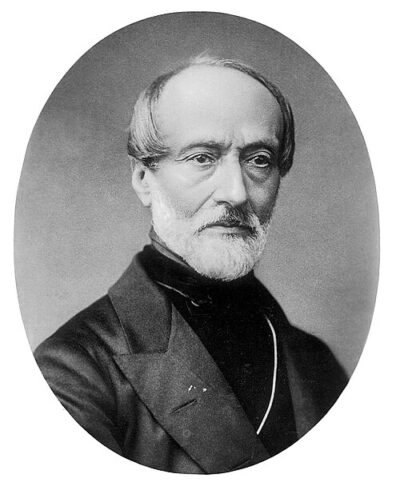
Giuseppe Mazzini
Giuseppe Mazzini was an Italian nationalist activist, politician, journalist and philosopher. Born June 22, 1805, in Genoa. Died March 10, 1872, in Pisa. Positions held include member of the Chamber of Deputies of the Kingdom of Italy (1865–1867). Educated at University of Genoa.
Facts
22 facts · 2 confirmed by two sources · 8 cited · 12 from one source
Where this comes from
Papalocal keeps its own record. It started from these sources; what each one said is kept here as it was copied, so a change on their side never changes this page by itself. Tap one to read its version.
What Wikidata says · copied November 16, 2026 · revision 2560185067
- Described as
- Italian nationalist activist, politician, journalist and philosopher
- Other names
- Joseph Mazzini, Giorgio Rossi Brown
- Born
- June 22, 1805 · 9 references
- Died
- March 10, 1872 · 11 references
- Born in
- Genoa · 3 references
- Died in
- Pisa · 4 references
- Buried in
- Mausoleum for Giuseppe Mazzini
- Cause of death
- pleurisy
- Citizen of
- Kingdom of Italy; France
- Occupation
- politician · 3 references; philosopher; writer · 2 references; journalist; literary critic · 1 reference; revolutionary · 1 reference; lawyer · 1 reference; jurist · 1 reference
- Positions held
- member of the Chamber of Deputies of the Kingdom of Italy (1865–1867) · 1 reference
- Political party
- Young Italy · 1 reference
- Education
- University of Genoa
- Field
- journalist
- Father
- Giacomo Mazzini
- Mother
- Maria Drago
- Wikipedias with a page
- 99
Wikidata item Q187336 (wikidata.org/wiki/Q187336), public domain (CC0). Copied November 16, 2026.
What Wikipedia says · copied November 16, 2026 · revision 1380021204
Giuseppe Mazzini (22 June 1805 – 10 March 1872) was an Italian politician, lawyer, journalist, philosopher, and political activist who worked for the unification of Italy (Risorgimento) and was a major leader of the Italian revolutionary movement. His efforts helped bring about the independent and unified Italy in place of the several separate states, many dominated by foreign powers, that existed until the 19th century. An Italian nationalist in the historical radical tradition and a proponent of a republicanism of social-democratic inspiration, Mazzini "helped define the European movement for popular democracy in a republican state." He is widely known as the "Prophet of Italian Nationalism".
Mazzini's thoughts influenced the Italian and European republican movements, the Constitution of Italy, and Europeanism, as well as later political leaders including Benito Mussolini, who was later the Fascist leader of Italy, former U.S. President Woodrow Wilson, former U.K. Prime Minister David Lloyd George, Indian independence movement figures such as Subhas Chandra Bose, Mahatma Gandhi, Jawaharlal Nehru, and Vinayak Damodar Savarkar, the founder of Hindutva. His ideas also influenced Sun Yat-sen, former President of the Provisional Government of the Republic of China (1912–1913), and founder of the Three Principles of the People (also known as Tridemism). In addition, Giuseppe Garibaldi, one of his most devoted followers, was deeply inspired by Mazzini's revolutionary vision and later played a decisive role in the Risorgimento through his military campaigns.
However, Mazzini's methods were often criticised, as his reliance on secret revolutionary groups and uprisings led to repeated failures and repression. Some historians also argue that his refusal to compromise with the monarchy made his goals harder to achieve, even though his ideas ultimately inspired the success of Italian unification.
- Born, in its opening lines
- June 22, 1805
- Died, in its opening lines
- March 10, 1872
From the Wikipedia article “Giuseppe Mazzini” (en.wikipedia.org/wiki/Giuseppe_Mazzini), by its contributors, under CC BY-SA 4.0 (creativecommons.org/licenses/by-sa/4.0/). Copied November 16, 2026; not changed.
Confirmed Two sources agree. Cited One source, and it names where it got it. One source One source, without a reference of its own. Sources disagree The sources disagree. We show the best-supported value and keep theirs below.
