
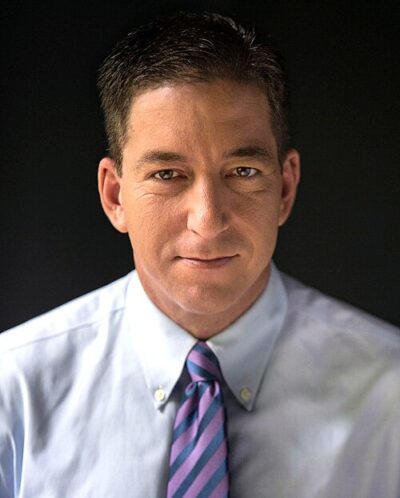
Glenn Greenwald
Glenn Greenwald is an American journalist, lawyer and writer. Born March 6, 1967, in Queens. Known for How Would a Patriot Act?, A Tragic Legacy and No Place to Hide. Educated at Nova High School and George Washington University. Awards include EFF Award, George Polk Award and Carl von Ossietzky Medal.
Facts
34 facts · 1 confirmed by two sources · 9 cited · 24 from one source
Where this comes from
Papalocal keeps its own record. It started from these sources; what each one said is kept here as it was copied, so a change on their side never changes this page by itself. Tap one to read its version.
What Wikidata says · copied November 14, 2026 · revision 2565450265
- Described as
- American journalist, lawyer and writer (born 1967)
- Other names
- Glenn Edward Greenwald
- Born
- March 6, 1967 · 2 references
- Born in
- Queens
- Name at birth
- Glenn Edward Greenwald
- Citizen of
- United States
- Occupation
- lawyer · 1 reference; journalist · 1 reference; writer; pundit; blogger; jurist · 2 references; columnist · 1 reference
- Worked for
- The Guardian (2012–2013); Salon.com (2007–2012); Wachtell, Lipton, Rosen & Katz (1994–1995); The Intercept (2014–2020) · 1 reference
- Education
- Nova High School · 1 reference; George Washington University (–1990); New York University School of Law (–1994)
- Known for
- How Would a Patriot Act?; A Tragic Legacy; No Place to Hide
- Awards
- EFF Award (2013) · 1 reference; George Polk Award (2014); Carl von Ossietzky Medal (2014); Izzy Award (2009) · 1 reference; I. F. Stone Hall of Fame (2014) · 1 reference; Geschwister-Scholl-Preis (2014); Preis für die Freiheit und Zukunft der Medien (2013); Hugh M. Hefner First Amendment Award
- Field
- global surveillance disclosures (2013–present)
- Spouse
- David Miranda (2005–2023) · 1 reference
- Religion
- Judaism
- Lived in
- Rio de Janeiro
- Website
- http://glenngreenwald.net/
- Wikipedias with a page
- 39
Wikidata item Q5568842 (wikidata.org/wiki/Q5568842), public domain (CC0). Copied November 14, 2026.
What Wikipedia says · copied November 14, 2026 · revision 1385402183
Glenn Edward Greenwald (born March 6, 1967) is an American journalist, author, and former lawyer.
In 1996, Greenwald founded a law firm concentrating on First Amendment litigation. He began blogging on national security issues in October 2005, when he became increasingly concerned with what he viewed as attacks on civil liberties by the George W. Bush administration in the aftermath of the September 11 attacks. He became a vocal critic of the Iraq War and has maintained a critical position on American foreign policy.
Greenwald started contributing to Salon in 2007, and to The Guardian in 2012. In June 2013, while at The Guardian, he began publishing a series of reports detailing previously unknown information about American and British global surveillance programs based on classified documents provided by Edward Snowden. His work contributed to The Guardian's 2014 Pulitzer Prize win and he was among a group of three reporters who won the 2013 George Polk Award. In 2014, he cofounded The Intercept, of which he was an editor until he resigned in October 2020. Greenwald subsequently started publishing his own newsletter.
Through The Intercept Brasil in June 2019, Greenwald published leaked conversations between senior officials involved in Operation Car Wash, a corruption case in Brazil. The conversations appeared to show the investigative judge acting prejudicially against Luiz Inácio Lula da Silva in the lead up to the 2018 elections. Greenwald was charged with cybercrimes by Brazilian prosecutors over the leaks in January 2020, though the charges were dismissed by a federal judge a month later. He now hosts the show System Update on Rumble.
- Born, in its opening lines
- March 6, 1967
From the Wikipedia article “Glenn Greenwald” (en.wikipedia.org/wiki/Glenn_Greenwald), by its contributors, under CC BY-SA 4.0 (creativecommons.org/licenses/by-sa/4.0/). Copied November 14, 2026; not changed.
Confirmed Two sources agree. Cited One source, and it names where it got it. One source One source, without a reference of its own. Sources disagree The sources disagree. We show the best-supported value and keep theirs below.
