
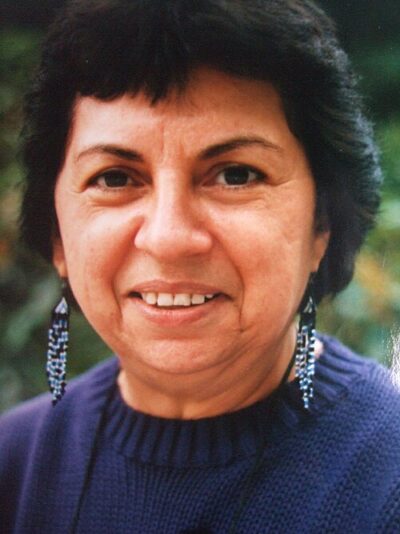
Gloria E. Anzaldúa
Gloria E. Anzaldúa was a Chicana cultural theory, feminist theory, and queer theory. Born September 26, 1942, in Raymondville. Died May 15, 2004, in Santa Cruz. Known for Borderlands/La Frontera: The New Mestiza, This Bridge Called My Back and Friends from the Other Side / Amigos del Otro Lado. Educated at Edinburg High School and University of Texas–Pan American. Awards include American Book Awards.
Facts
29 facts · 2 confirmed by two sources · 12 cited · 15 from one source
Where this comes from
Papalocal keeps its own record. It started from these sources; what each one said is kept here as it was copied, so a change on their side never changes this page by itself. Tap one to read its version.
What Wikidata says · copied November 16, 2026 · revision 2558022824
- Described as
- Chicana cultural theory, feminist theory, and queer theory (1942-2004)
- Other names
- Gloria E. Anzaldua, Gloria Evangelina Anzaldúa
- Born
- September 26, 1942 · 3 references
- Died
- May 15, 2004 · 3 references
- Born in
- Raymondville · 1 reference
- Died in
- Santa Cruz · 1 reference
- Buried in
- Valle De La Paz Cemetery · 1 reference
- Cause of death
- diabetes
- Name at birth
- Gloria Evangelina Anzaldúa · 1 reference
- Citizen of
- Mexico
- Occupation
- writer · 2 references; poet; literary critic; children's writer; journalist; novelist · 1 reference; philosopher; queer theorist
- Worked for
- University of California, Santa Cruz; San Francisco State University · 1 reference
- Education
- Edinburg High School (–1962) · 1 reference; University of Texas–Pan American; University of Texas Rio Grande Valley
- Known for
- Borderlands/La Frontera: The New Mestiza · 1 reference; This Bridge Called My Back · 1 reference; Friends from the Other Side / Amigos del Otro Lado
- Awards
- American Book Awards (1986)
- Lived in
- San Francisco Bay Area (1977–1981) · 1 reference; Northern California (1985–) · 1 reference; Brooklyn (1982–1985) · 1 reference; Santa Cruz · 1 reference
- Wikipedias with a page
- 31
Wikidata item Q3109110 (wikidata.org/wiki/Q3109110), public domain (CC0). Copied November 16, 2026.
What Wikipedia says · copied November 16, 2026 · revision 1383471354
Gloria Evangelina Anzaldúa (September 26, 1942 – May 15, 2004) was an Chicana philosopher and scholar of Chicana feminism, cultural theory, and queer theory. She loosely based her best-known book, Borderlands/La Frontera: The New Mestiza (1987), on her life growing up on the Mexico–Texas border and incorporated her lifelong experiences of social and cultural marginalization into her work. She also developed theories about the marginal, in-between, and mixed cultures that develop along borders, including on the concepts of Nepantla, Coyoxaulqui imperative, new tribalism, and spiritual activism. Her other notable publications include This Bridge Called My Back: Writings by Radical Women of Color (1981), co-edited with Cherríe Moraga.
Born in Río Grande Valley of South Texas, she worked as a teacher and writer until she moved to California in 1977. She died in 2004 while completing a doctorate in literature at the University of California, Santa Cruz, which was awarded post-humously in 2005; her unfinished dissertation was published as Light in the Dark/Luz en los Oscuro in 2015.
- Born, in its opening lines
- September 26, 1942
- Died, in its opening lines
- May 15, 2004
From the Wikipedia article “Gloria Anzaldúa” (en.wikipedia.org/wiki/Gloria_Anzaldúa), by its contributors, under CC BY-SA 4.0 (creativecommons.org/licenses/by-sa/4.0/). Copied November 16, 2026; not changed.
Confirmed Two sources agree. Cited One source, and it names where it got it. One source One source, without a reference of its own. Sources disagree The sources disagree. We show the best-supported value and keep theirs below.
