
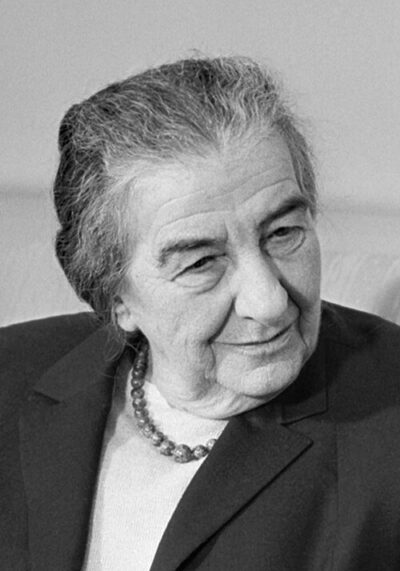
Golda Meir
Golda Meir was a Prime Minister of Israel from 1969 to 1974. Born May 3, 1898, in Ukraine. Died December 8, 1978, in West Jerusalem. Positions held include Prime Minister of Israel (1969–1974), Minister of Foreign Affairs, Israel (1956–1966) and Knesset member (1949–1974). Educated at University of Wisconsin–Milwaukee and North Division High School. Awards include Colorado Women's Hall of Fame, Israel Prize and honorary doctor of the Bar-Ilan University.
Facts
46 facts · 2 confirmed by two sources · 8 cited · 35 from one source · 1 where the sources disagree
What’s different
- Born in: we show Ukraine (Sources disagree). Wikidata also lists Kyiv and Russian Empire
Where this comes from
Papalocal keeps its own record. It started from these sources; what each one said is kept here as it was copied, so a change on their side never changes this page by itself. Tap one to read its version.
What Wikidata says · copied November 16, 2026 · revision 2567482893
- Described as
- Prime Minister of Israel from 1969 to 1974
- Other names
- Golda Mabovich, Golda Meyerson
- Born
- May 3, 1898 · 5 references
- Died
- December 8, 1978 · 10 references
- Born in
- Kyiv · 1 reference; Russian Empire; Ukraine · 2 references
- Died in
- West Jerusalem
- Buried in
- Mount Herzl
- Cause of death
- leukemia
- Name at birth
- גולדה מאבוביץ' · 1 reference
- Citizen of
- Mandatory Palestine; Israel
- Occupation
- teacher · 1 reference; politician · 1 reference; librarian · 1 reference
- Positions held
- Prime Minister of Israel (1969–1974); Minister of Foreign Affairs, Israel (1956–1966) · 1 reference; Knesset member (1949–1974) · 1 reference; Minister of the Interior of Israel (1970); Labor Minister of Israel (1949–1956); ambassador of Israel to the Soviet Union (1948–1949) · 1 reference
- Political party
- Mapai; Alignment; Israeli Labor Party
- Education
- University of Wisconsin–Milwaukee; North Division High School · 1 reference; Wisconsin State College of Milwaukee
- Member of
- Jewish National Council; Seventh government of Israel (1956) · 1 reference
- Awards
- Colorado Women's Hall of Fame (1985) · 1 reference; Israel Prize (1975); honorary doctor of the Bar-Ilan University; honorary doctor of the Hebrew University of Jerusalem; honorary doctor of Brandeis University; Order of the Quetzal · 1 reference; Order of the Liberator · 1 reference; Order of the Equatorial Star · 1 reference; Order of José Matías Delgado · 1 reference; honorary citizen of Jerusalem
- Spouse
- Morris Meyerson (1917–1951)
- Children
- Menachem Meir
- Father
- Moshe Mabovitch
- Religion
- atheism; Judaism · 1 reference
- Lived in
- Pinsk (1903–1906); Milwaukee (1906–1921); Denver (1912–1913); Merhavia (1921–1924); Jerusalem (2 times) (1924–1978)
- Wikipedias with a page
- 138
Wikidata item Q42992 (wikidata.org/wiki/Q42992), public domain (CC0). Copied November 16, 2026.
What Wikipedia says · copied November 16, 2026 · revision 1385550644
Golda Meir (previously Meyerson; née Mabovitch; 3 May 1898 – 8 December 1978) was a Ukrainian-American-Israeli stateswoman, trade unionist, activist, and teacher who served as the prime minister of Israel from 1969 to 1974. She was Israel's first and, to date, only female head of government.
Born into a Ukrainian-Jewish family in Kiev, Russian Empire, Meir immigrated with her family to the United States in 1906. She graduated from the Milwaukee State Normal School and found work as a teacher. While in Milwaukee, she embraced the Labor Zionist movement. In 1921, Meir and her husband immigrated to Mandatory Palestine, settling in Merhavia, later becoming the kibbutz's representative to the Histadrut. In 1934, she was elevated to the executive committee of the trade union. Meir held several key roles in the Jewish Agency during and after World War II. She was a signatory of the Israeli Declaration of Independence, in 1948. Meir was elected to the Knesset, in 1949, and served as Labor Minister until 1956, when she was appointed Foreign Minister by Prime Minister David Ben-Gurion. She retired from the ministry in 1966 due to ill health.
In 1969, Meir assumed the role of prime minister following the death of Levi Eshkol. Early in her tenure, she made multiple diplomatic visits to western leaders to promote her vision of peace in the region. The outbreak of the Yom Kippur War in 1973 caught Israel off guard and inflicted severe early losses on the army. The resulting public anger damaged Meir's reputation and led to an inquiry into the failings. Her Alignment coalition was denied a majority in the subsequent legislative election; she resigned the following year and was succeeded as prime minister by Yitzhak Rabin. Meir died in 1978 of lymphoma and was buried on Mount Herzl.
A controversial figure in Israel, Meir has been lionized as a founder of the state and described as the "Iron Lady" of Israeli politics, but also widely blamed for the country being caught by surprise during the war of 1973. In addition, her dismissive statements towards the Palestinians have been described as the most famous example of Israeli denial of Palestinian identity. Most historians believe Meir was more successful as Minister of Labour and Housing than as Premier.
- Born, in its opening lines
- May 3, 1898
- Died, in its opening lines
- December 8, 1978
From the Wikipedia article “Golda Meir” (en.wikipedia.org/wiki/Golda_Meir), by its contributors, under CC BY-SA 4.0 (creativecommons.org/licenses/by-sa/4.0/). Copied November 16, 2026; not changed.
Confirmed Two sources agree. Cited One source, and it names where it got it. One source One source, without a reference of its own. Sources disagree The sources disagree. We show the best-supported value and keep theirs below.
