
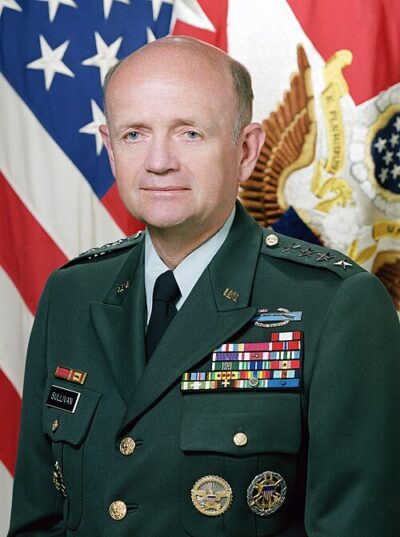
Gordon R. Sullivan
Gordon R. Sullivan was an American general. Born September 25, 1937, in Boston. Died January 2, 2024. Positions held include Vice Chief of Staff of the United States Army (1990–1991) and Chief of Staff of the United States Army (1991–1995). Educated at United States Army Command and General Staff College and Norwich University. Awards include Bronze Star Medal, Legionnaire of Legion of Merit and Gold Cross of Honour of the Bundeswehr.
Facts
18 facts · 2 confirmed by two sources · 2 cited · 14 from one source
Where this comes from
Papalocal keeps its own record. It started from these sources; what each one said is kept here as it was copied, so a change on their side never changes this page by itself. Tap one to read its version.
What Wikidata says · copied November 19, 2026 · revision 2571586698
- Described as
- American general (1937–2024)
- Other names
- Gordon Russell Sullivan
- Born
- September 25, 1937 · 1 reference
- Died
- January 2, 2024 · 1 reference
- Born in
- Boston · 1 reference
- Buried in
- Arlington National Cemetery
- Citizen of
- United States
- Occupation
- military personnel
- Positions held
- Vice Chief of Staff of the United States Army (1990–1991); Chief of Staff of the United States Army (1991–1995) · 1 reference
- Education
- United States Army Command and General Staff College; Norwich University; United States Army War College; Thayer Academy · 1 reference
- Awards
- Bronze Star Medal; Legionnaire of Legion of Merit; Gold Cross of Honour of the Bundeswehr; Purple Heart; Medal of Military Merit (1994) · 2 references
- Military rank
- general
- Wikipedias with a page
- 12
Wikidata item Q239649 (wikidata.org/wiki/Q239649), public domain (CC0). Copied November 19, 2026.
What Wikipedia says · copied November 19, 2026 · revision 1379821449
Gordon Russell Sullivan (25 September 1937 – 2 January 2024) was an American general who served as the 32nd chief of staff of the United States Army from 1991 to 1995, and as the acting United States secretary of the Army in 1993. Sullivan was commissioned into the Armor Branch in 1959 through Norwich University's Army Reserve Officers' Training Corps. Early in his career, he served a tour in South Korea and two tours during the Vietnam War. He was a military advisor to South Vietnam during his first combat tour, from 1963 to 1964. He was later a staff officer there in the late 1960s. Sullivan also served four tours in West Germany, where he was a staff officer and a company, battalion, and brigade commander.
As a general officer, Sullivan was the deputy commander of the United States Army Armor School from 1983 to 1985 and of the Army Command and General Staff College from 1987 to 1988. He was also the commanding general of the 1st Infantry Division from 1988 to 1989, and then served as deputy chief of staff for operations and plans of the United States Army from 1989 to 1990. He then became the 22nd vice chief of staff of the United States Army. As the chief of staff from 1991, Sullivan presided over one of the largest force reductions in Army history, in terms of soldiers, bases, and posts. He oversaw the restructuring of the Army as it shifted from its Cold War focus on a land war in Europe or Asia to interventions in other parts of the world. Also during his tenure, Army troops were deployed for peacekeeping missions in several areas, including Somalia and Haiti.
After retiring from the Army in 1995, Sullivan worked in several organizations. He served as the president and chief executive of the Association of the United States Army from 1998 to 2016. He had also been the chairman of the boards of the Army Historical Foundation and the Marshall Legacy Institute. Sullivan died in 2024 at the age of 86.
- Born, in its opening lines
- September 25, 1937
- Died, in its opening lines
- January 2, 2024
From the Wikipedia article “Gordon R. Sullivan” (en.wikipedia.org/wiki/Gordon_R._Sullivan), by its contributors, under CC BY-SA 4.0 (creativecommons.org/licenses/by-sa/4.0/). Copied November 19, 2026; not changed.
Confirmed Two sources agree. Cited One source, and it names where it got it. One source One source, without a reference of its own. Sources disagree The sources disagree. We show the best-supported value and keep theirs below.
