
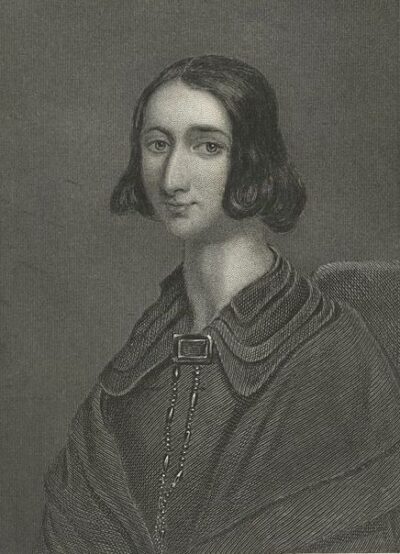
Grace Aguilar
Grace Aguilar was an English novelist, poet and writer on Jewish history and religion. Born June 2, 1816, in Hackney. Died September 16, 1847, in Frankfurt. Known for The Days of Bruce and The Women of Israel.
Facts
17 facts · 2 confirmed by two sources · 3 cited · 12 from one source
Where this comes from
Papalocal keeps its own record. It started from these sources; what each one said is kept here as it was copied, so a change on their side never changes this page by itself. Tap one to read its version.
What Wikidata says · copied November 16, 2026 · revision 2565606714
- Described as
- English novelist, poet and writer on Jewish history and religion
- Other names
- Agular, Gratsyah, Agular, Hanah, Agular, Gereciah, Agular, Gracyah
- Born
- June 2, 1816 · 9 references
- Died
- September 16, 1847 · 9 references
- Born in
- Hackney · 2 references
- Died in
- Frankfurt · 2 references
- Buried in
- Neuer Jüdischer Friedhof (Eckenheimer Landstraße) · 1 reference
- Citizen of
- United Kingdom of Great Britain and Ireland; British Empire · 1 reference
- Occupation
- poet; historian; writer · 3 references; novelist · 1 reference; translator · 1 reference; theologian
- Known for
- The Days of Bruce; The Women of Israel
- Field
- poetry
- Religion
- Judaism
- Wikipedias with a page
- 29
Wikidata item Q298152 (wikidata.org/wiki/Q298152), public domain (CC0). Copied November 16, 2026.
What Wikipedia says · copied November 16, 2026 · revision 1382778483
Grace Aguilar (2 June 1816 – 16 September 1847) was an English novelist, poet and writer on Jewish history and religion. Although she had been writing since childhood, much of her work was published posthumously. Among those are her best known works, the novels Home Influence and A Mother's Recompense.
Aguilar was the eldest child of Sephardic Jewish refugees from Portugal - Emmanuel and Sara - who settled in the London Borough of Hackney in Paragon Terrace/Road and 5, West(gate) Street, Triangle, and later 1, Clarence Place, Clapton. An early illness resulted in her being educated by her parents, especially her mother, who taught her the tenets of Judaism. Later, her father taught the history of Spanish and Portuguese Jews during his own bout with tuberculosis which had led the family to move to the English coast. After surviving the measles at the age of 19, she began to embark on a serious writing career, even though her physical health never completely recovered.
Aguilar's debut was an anonymous collection of poems, The Magic Wreath of Hidden Flowers. Three years later she translated Isaac Orobio de Castro's Israel Defended into English at her father's behest. Later her The Spirit of Judaism drew interest and sales in both Britain and the United States after being published in Philadelphia by Isaac Leeser. He added a preface to the work elucidating his differences with her, the first of many clashes her work would have with mainstream Jewish thought.
In the 1840s her novels began to attract regular readers, and Aguilar moved back to London with her parents. Despite her success, she and her mother still had to operate a boys' Hebrew school to stay solvent, which she resented for the time and energy it took from her writing. In 1847, she became ill again with a spinal paralysis which she did not let prevent her from visiting her brother, the pianist Emanuel Abraham Aguilar, in Frankfurt. Her health worsened and she died there that September.
- Born, in its opening lines
- June 2, 1816
- Died, in its opening lines
- September 16, 1847
From the Wikipedia article “Grace Aguilar” (en.wikipedia.org/wiki/Grace_Aguilar), by its contributors, under CC BY-SA 4.0 (creativecommons.org/licenses/by-sa/4.0/). Copied November 16, 2026; not changed.
Confirmed Two sources agree. Cited One source, and it names where it got it. One source One source, without a reference of its own. Sources disagree The sources disagree. We show the best-supported value and keep theirs below.
