
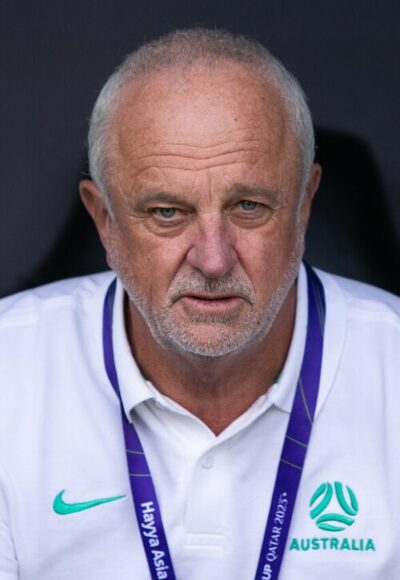
Graham Arnold
Graham Arnold is an Australian association football player and coach. Born August 3, 1963, in Sydney. Teams include Northern Spirit FC (1999–2001), Sydney United FC (1982–1990) and R.F.C. de Liège (1992–1994).
Facts
18 facts · 1 confirmed by two sources · 3 cited · 14 from one source
Where this comes from
Papalocal keeps its own record. It started from these sources; what each one said is kept here as it was copied, so a change on their side never changes this page by itself. Tap one to read its version.
What Wikidata says · copied November 16, 2026 · revision 2550827602
- Described as
- Australian association football player and coach
- Other names
- Graham James Arnold
- Born
- August 3, 1963 · 1 reference
- Born in
- Sydney
- Name at birth
- Graham James Arnold · 1 reference
- Citizen of
- Australia
- Occupation
- association football player · 1 reference; association football coach · 1 reference
- Teams
- Northern Spirit FC (1999–2001); Sydney United FC (1982–1990); R.F.C. de Liège (1992–1994); Sanfrecce Hiroshima (1997–1998); Royal Charleroi S.C. (1994–1995); NAC Breda (1995–1997); Bankstown Berries FC (1980–1981); Roda JC Kerkrade (1990–1992); Australia men's national soccer team (1985–1997); Australia national under-23 soccer team · 1 reference
- Sport
- association football
- Height
- 1.79 m (5 ft 10 in) · 1 reference
- Wikipedias with a page
- 50
Wikidata item Q1336203 (wikidata.org/wiki/Q1336203), public domain (CC0). Copied November 16, 2026.
What Wikipedia says · copied November 16, 2026 · revision 1385634895
Graham James Arnold (born 3 August 1963) is an Australian professional football manager and former player who is the head coach of the Iraq national team.
Arnold was first appointed to work as assistant coach of the Australian men's national soccer team (the Socceroos) in 2000. After head coach Frank Farina was sacked in 2005, Arnold worked with Guus Hiddink for the 2006 FIFA World Cup campaign, in which they made the second round of the finals. After Hiddink left, he became interim coach of the Socceroos. Arnold went on to qualify Australia's U23 men's national soccer team (nicknamed the Olyroos) for the 2008 Beijing Olympics. Arnold then went on to assist Pim Verbeek for qualification of the 2010 FIFA World Cup in South Africa.
Arnold's next move was to take the manager role at struggling A-League club the Central Coast Mariners between 2010 and 2013, where he guided the club to a Premiership and a Championship. He went on to win two Premierships, one Championship and an FFA Cup with Sydney FC.
In 2018, Arnold replaced Bert van Marwijk as Australian coach after the 2018 FIFA World Cup. Under Arnold, Australia qualified for the 2022 FIFA World Cup, during which Australia achieved their most successful World Cup campaign: after recording multiple group stage wins for the first time, with their only group stage loss being to eventual runners-up France, Australia qualified for the Round of 16 for the second time in their history, where they narrowly lost to eventual champions Argentina. He resigned from the role in September 2024. He was appointed head coach of the Iraq national team.
Arnold holds a number of A-League records: he has managed the fourth most games of any manager in the A-League (211), he has achieved the third most wins in the competition's history (116), he has the third-best career winning percentage of any A-League manager with 30+ games managed (54.9%), he has the best career unbeaten percentage of any A-League manager (81.5%), and he is one of just three managers to have won multiple A-League championships. Arnold also holds the records for most games coached, and most games won, as manager of Australia. He is a member of the Football Federation Australia Football Hall of Fame.
- Born, in its opening lines
- August 3, 1963
From the Wikipedia article “Graham Arnold” (en.wikipedia.org/wiki/Graham_Arnold), by its contributors, under CC BY-SA 4.0 (creativecommons.org/licenses/by-sa/4.0/). Copied November 16, 2026; not changed.
Confirmed Two sources agree. Cited One source, and it names where it got it. One source One source, without a reference of its own. Sources disagree The sources disagree. We show the best-supported value and keep theirs below.
