
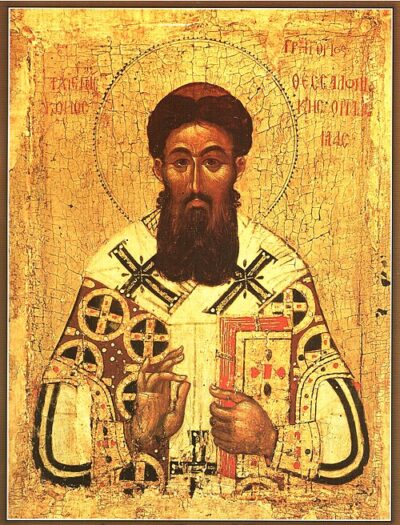
Gregory Palamas
Gregory Palamas was the 14th century Byzantine Greek cleric and theologian. Born November 1296, in Constantinople. Died November 14, 1359, in Thessaloniki.
Facts
12 facts · 2 confirmed by two sources · 5 cited · 5 from one source
Where this comes from
Papalocal keeps its own record. It started from these sources; what each one said is kept here as it was copied, so a change on their side never changes this page by itself. Tap one to read its version.
What Wikidata says · copied November 16, 2026 · revision 2557899280
- Described as
- 14th century Byzantine Greek cleric and theologian
- Other names
- Gregorios Palamas, Grigorios Palamas
- Born
- November 1296 · 1 reference
- Died
- November 14, 1359
- Born in
- Constantinople · 2 references
- Died in
- Thessaloniki · 2 references
- Citizen of
- Byzantine Empire
- Occupation
- philosopher; writer; Eastern Orthodox priest; mystic · 1 reference; theologian · 1 reference; metropolitan · 1 reference
- Religion
- Eastern Orthodoxy
- Wikipedias with a page
- 50
Wikidata item Q243787 (wikidata.org/wiki/Q243787), public domain (CC0). Copied November 16, 2026.
What Wikipedia says · copied November 16, 2026 · revision 1371878696
Gregory Palamas (; Byzantine Greek: Γρηγόριος Παλαμᾶς, romanized: Grēgórios Palamâs, pronounced [ɣriˈɣori.os palaˈmas]; c. 1296 – 14 November 1359) was a Byzantine Greek theologian and Eastern Orthodox cleric of the late Byzantine period. A monk of Mount Athos (modern Greece) and later archbishop of Thessalonica, he is famous for his defense of hesychast spirituality, the uncreated character of the light of the Transfiguration, and the distinction between God's essence and energies (i.e., the divine will, divine grace, etc.). His teaching unfolded over the course of three major controversies, (1) with the Italo-Greek Barlaam between 1336 and 1341, (2) with the monk Gregory Akindynos between 1341 and 1347, and (3) with the philosopher Gregoras, from 1348 to 1355. His theological contributions are sometimes referred to as Palamism, and his followers as Palamites.
Gregory has been venerated as a saint in the Eastern Orthodox Church since 1368. Within the Post Vatican II Catholic Church, he has also been called a saint; Pope John Paul II repeatedly called Gregory a great theological writer. Since 1971, the Melkite Greek Catholic Church has venerated Gregory as a saint. Some of his writings are collected in the Philokalia, and since the Ottoman period, the second Sunday of Great Lent is dedicated to the memory of Gregory Palamas in most branches of the Eastern Orthodoxy, while in some Eastern Catholic Churches, the issue is disputed.
- Born, in its opening lines
- c. 1296
- Died, in its opening lines
- November 14, 1359
From the Wikipedia article “Gregory Palamas” (en.wikipedia.org/wiki/Gregory_Palamas), by its contributors, under CC BY-SA 4.0 (creativecommons.org/licenses/by-sa/4.0/). Copied November 16, 2026; not changed.
Confirmed Two sources agree. Cited One source, and it names where it got it. One source One source, without a reference of its own. Sources disagree The sources disagree. We show the best-supported value and keep theirs below.
