
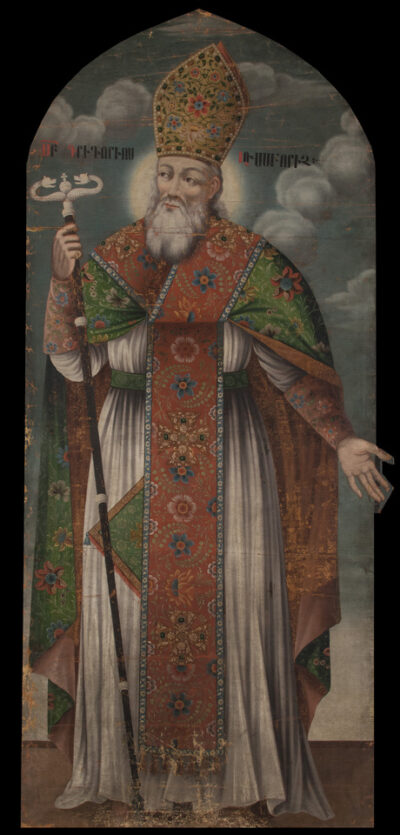
Gregory the Illuminator
Gregory the Illuminator was a patron saint of the Armenian Apostolic Church (c.257–c.331). Born 239, in Armenia. Died 329. Positions held include Catholicos of All Armenians (302–).
Facts
12 facts · 0 confirmed by two sources · 8 cited · 3 from one source · 1 where the sources disagree
What’s different
- Died: we show 329 (Sources disagree). Wikidata also lists 325 and 326
Where this comes from
Papalocal keeps its own record. It started from these sources; what each one said is kept here as it was copied, so a change on their side never changes this page by itself. Tap one to read its version.
What Wikidata says · copied November 16, 2026 · revision 2557424727
- Described as
- patron saint of the Armenian Apostolic Church (c.257–c.331)
- Other names
- Saint Gregory the Illuminator
- Born
- 239 · 2 references
- Died
- 329 · 2 references; 325 · 1 reference; 326 · 1 reference
- Born in
- Armenia
- Occupation
- religious leader · 1 reference; presbyter; illuminator · 1 reference
- Positions held
- Catholicos of All Armenians (302–) · 1 reference
- Spouse
- Julitta of Armenia · 1 reference
- Children
- St. Vrtanes I · 2 references; St. Aristaces I · 2 references
- Father
- Anak the Parthian · 2 references
- Religion
- Armenian Apostolic Church
- Wikipedias with a page
- 47
Wikidata item Q309953 (wikidata.org/wiki/Q309953), public domain (CC0). Copied November 16, 2026.
What Wikipedia says · copied November 16, 2026 · revision 1383578596
Gregory the Illuminator (c. 257 – c. 331) was the founder and first official head of the Armenian Apostolic Church. He converted Armenia from Zoroastrianism to Christianity in the early fourth century (traditionally dated to 301), making Armenia the first state to adopt Christianity as its official religion. He is venerated as a saint in the Armenian Apostolic Church and in some other churches.
Gregory is said to have been the son of a Parthian nobleman, Anak, who assassinated Khosrov, the Arsacid king of Armenia. The young Gregory was saved from the extermination of Anak's family and was raised as a Christian in Caesarea of Cappadocia, then part of the Roman Empire. Gregory returned to Armenia as an adult and entered the service of King Tiridates III, who had Gregory tortured after he refused to make a sacrifice to a pagan goddess. After discovering Gregory's true identity, Tiridates had him thrown into a deep pit well called Khor Virap for 14 years. Gregory was miraculously saved from death and released after many years with the help of Tiridates' sister Khosrovidukht. Gregory then converted the King to Christianity, and Armenia then, in 301 AD, became the first country to adopt Christianity as a state religion. Gregory the Illuminator then healed King Tiridates, whom the hagiographical sources say had been driven mad by his sins, and preached Christianity in Armenia. He was consecrated bishop of Armenia at Caesarea, baptized King Tiridates and the Armenian people, and traveled throughout Armenia, destroying pagan temples and building churches in their place.
Gregory eventually gave up the patriarchate to live as a hermit and was succeeded by his son Aristaces. Gregory's descendants, called the Gregorids, hereditarily held the office of Patriarch of Armenia with some interruptions until the fifth century. It is in Gregory's honor that the Armenian Church is sometimes called lusavorchakan ("of the Illuminator") or Gregorian.
From the Wikipedia article “Gregory the Illuminator” (en.wikipedia.org/wiki/Gregory_the_Illuminator), by its contributors, under CC BY-SA 4.0 (creativecommons.org/licenses/by-sa/4.0/). Copied November 16, 2026; not changed.
Confirmed Two sources agree. Cited One source, and it names where it got it. One source One source, without a reference of its own. Sources disagree The sources disagree. We show the best-supported value and keep theirs below.
