
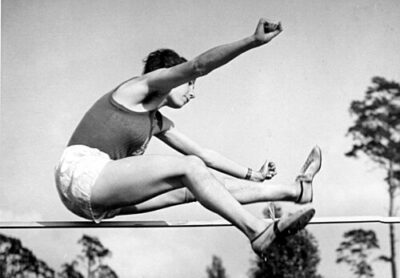
Gretel Bergmann was a German high jumper. Born April 12, 1914, in Laupheim. Died July 25, 2017, in Queens. Awards include Germany's Sports Hall of Fame and Georg von Opel Award.
Facts
12 facts · 2 confirmed by two sources · 3 cited · 7 from one source
Where this comes from
Papalocal keeps its own record. It started from these sources; what each one said is kept here as it was copied, so a change on their side never changes this page by itself. Tap one to read its version.
What Wikidata says · copied November 18, 2026 · revision 2571578571
- Described as
- German high jumper
- Other names
- Gretel Lambert
- Born
- April 12, 1914 · 3 references
- Died
- July 25, 2017 · 1 reference
- Born in
- Laupheim · 2 references
- Died in
- Queens · 1 reference
- Citizen of
- Germany; United States
- Occupation
- athletics competitor; athlete · 1 reference
- Sport
- athletics
- Awards
- Germany's Sports Hall of Fame (2012–); Georg von Opel Award (1999)
- Lived in
- Queens · 1 reference
- Wikipedias with a page
- 19
Wikidata item Q214313 (wikidata.org/wiki/Q214313), public domain (CC0). Copied November 18, 2026.
What Wikipedia says · copied November 18, 2026 · revision 1386379744
Gretel Lambert (born Margarethe Bergmann; April 12, 1914 – July 25, 2017) was a German Jewish track and field athlete who competed as a high jumper during the 1930s.
Due to her Jewish origins, the Nazis prevented her from taking part in the 1936 Summer Olympics, after which she left Germany and vowed never to return. She however visited Germany in 2004 to meet with her 1930s rival Elfriede Kaun, whom she considered a friend. Bergmann turned 100 in 2014. She died in 2017 at her home in Jamaica Estates, Queens, New York.
- Born, in its opening lines
- April 12, 1914
- Died, in its opening lines
- July 25, 2017
From the Wikipedia article “Gretel Bergmann” (en.wikipedia.org/wiki/Gretel_Bergmann), by its contributors, under CC BY-SA 4.0 (creativecommons.org/licenses/by-sa/4.0/). Copied November 18, 2026; not changed.
Confirmed Two sources agree. Cited One source, and it names where it got it. One source One source, without a reference of its own. Sources disagree The sources disagree. We show the best-supported value and keep theirs below.
