
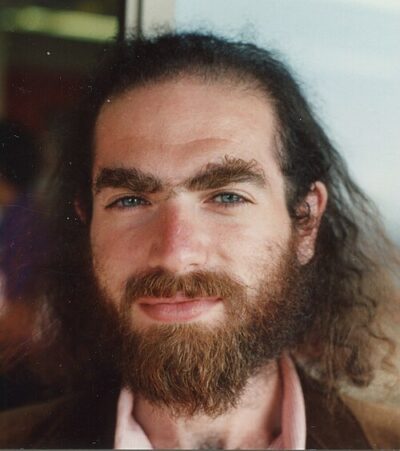
Grigori Perelman
Grigori Perelman is a Russian mathematician. Born June 13, 1966, in Saint Petersburg. Known for Poincaré conjecture, geometrization conjecture and soul theorem. Educated at Mathematics and Mechanics Faculty, St. Petersburg State University and Saint Petersburg Lyceum 239. Awards include Fields medal, EMS Prize and Millennium Problems.
Facts
29 facts · 1 confirmed by two sources · 8 cited · 20 from one source
Where this comes from
Papalocal keeps its own record. It started from these sources; what each one said is kept here as it was copied, so a change on their side never changes this page by itself. Tap one to read its version.
What Wikidata says · copied November 16, 2026 · revision 2567047212
- Described as
- Russian mathematician (born 1966)
- Other names
- Grigori Yakovlevich Perelman, Григорий Яковлевич Перельман, Grigori Jakowlewitsch Perelman
- Born
- June 13, 1966 · 5 references
- Born in
- Saint Petersburg · 1 reference
- Citizen of
- Soviet Union (–1991); Russia (1991–)
- Occupation
- mathematician · 1 reference
- Worked for
- St. Petersburg Department of Steklov Institute of Mathematics of Russian Academy of Sciences (–2005) · 2 references; Courant Institute School of Mathematics, Computing, and Data Science; Stony Brook University; University of California, Berkeley
- Education
- Mathematics and Mechanics Faculty, St. Petersburg State University (1982–1987) · 2 references; Saint Petersburg Lyceum 239
- Known for
- Poincaré conjecture; geometrization conjecture; soul theorem; The entropy formula for the Ricci flow and its geometric applications; Ricci flow with surgery on three-manifolds; Finite extinction time for the solutions to the Ricci flow on certain three-manifolds
- Awards
- Fields medal (2006) · 1 reference; EMS Prize (1996); Millennium Problems (2010) · 1 reference
- Field
- differential geometry; topology; mathematics; Riemannian geometry; geometric topology
- Father
- Yakov Perelman · 1 reference
- Mother
- Lyubov Steingolts · 1 reference
- Siblings
- Elena Perelman · 1 reference
- Lived in
- Kupchino
- Wikipedias with a page
- 80
Wikidata item Q117346 (wikidata.org/wiki/Q117346), public domain (CC0). Copied November 16, 2026.
What Wikipedia says · copied November 16, 2026 · revision 1382894871
Grigori Yakovlevich Perelman (Russian: Григорий Яковлевич Перельман, pronounced [ɡrʲɪˈɡorʲɪj ˈjakəvlʲɪvʲɪtɕ pʲɪrʲɪlʲˈman] ; born 13 June 1966) is a Russian mathematician and geometer who is known for his contributions to the fields of geometric analysis, Riemannian geometry, and geometric topology. In 2005, Perelman resigned from his research post in Steklov Institute of Mathematics and in 2006 stated that he had quit professional mathematics, owing to feeling disappointed over the ethical standards in the field. He lives in seclusion in Saint Petersburg and has declined requests for interviews since 2006.
In the 1990s, partly in collaboration with Yuri Burago, Mikhael Gromov, and Anton Petrunin, he made contributions to the study of Alexandrov spaces. In 1994, he proved the soul conjecture in Riemannian geometry, which had been an open problem for the previous 20 years. In 2002 and 2003, he developed new techniques in the analysis of Ricci flow, and proved the Poincaré conjecture and Thurston's geometrization conjecture, the former of which had been a famous open problem in mathematics for the past century. The full details of Perelman's work were filled in and explained by various authors over the following several years.
In August 2006, Perelman was offered the Fields Medal for "his contributions to geometry and his revolutionary insights into the analytical and geometric structure of the Ricci flow", but he declined the award, stating: "I'm not interested in money or fame; I don't want to be on display like an animal in a zoo." On 22 December 2006, the scientific journal Science recognized Perelman's proof of the Poincaré conjecture as the scientific "Breakthrough of the Year", the first such recognition in the area of mathematics.
On 18 March 2010, it was announced that he had met the criteria to receive the first Clay Millennium Prize for resolution of the Poincaré conjecture. On 1 July 2010, he rejected the prize of one million dollars, saying that he considered the decision of the board of the Clay Institute to be unfair, in that his contribution to solving the Poincaré conjecture was no greater than that of Richard S. Hamilton, the mathematician who pioneered the Ricci flow partly with the aim of attacking the conjecture. He had previously rejected the prestigious prize of the European Mathematical Society in 1996.
- Born, in its opening lines
- June 13, 1966
From the Wikipedia article “Grigori Perelman” (en.wikipedia.org/wiki/Grigori_Perelman), by its contributors, under CC BY-SA 4.0 (creativecommons.org/licenses/by-sa/4.0/). Copied November 16, 2026; not changed.
Confirmed Two sources agree. Cited One source, and it names where it got it. One source One source, without a reference of its own. Sources disagree The sources disagree. We show the best-supported value and keep theirs below.
