
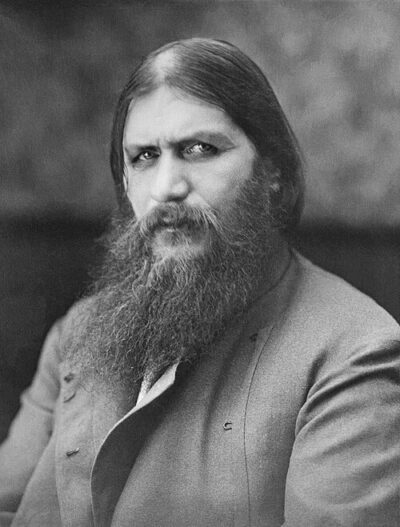
Grigori Rasputin
Grigori Rasputin was a Russian mystic. Born January 9, 1869, in Pokrovskoye. Died December 17, 1916, in Saint Petersburg.
Facts
15 facts · 0 confirmed by two sources · 3 cited · 9 from one source · 3 where the sources disagree
What’s different
- Born: we show January 9, 1869 (Sources disagree). Wikipedia says January 21, 1869
- Died: we show December 17, 1916 (Sources disagree). Wikipedia says December 30, 1916
- Cause of death: we show drowning (Sources disagree). Wikidata also lists gunshot wound
Where this comes from
Papalocal keeps its own record. It started from these sources; what each one said is kept here as it was copied, so a change on their side never changes this page by itself. Tap one to read its version.
What Wikidata says · copied November 16, 2026 · revision 2568620748
- Described as
- Russian mystic (1869–1916)
- Other names
- Grigori Yefimovich Rasputin, Rasputin
- Born
- January 9, 1869 · 1 reference
- Died
- December 17, 1916 · 4 references
- Born in
- Pokrovskoye
- Died in
- Saint Petersburg · 2 references
- Cause of death
- drowning; gunshot wound
- Occupation
- mystic; occultist; politician; peasant; monk · 2 references; consultant · 1 reference
- Spouse
- Praskovia Fyodorovna Dubrovina · 2 references
- Children
- Maria Rasputin; Varvara Rasputina
- Religion
- Christianity
- Wikipedias with a page
- 111
Wikidata item Q43989 (wikidata.org/wiki/Q43989), public domain (CC0). Copied November 16, 2026.
What Wikipedia says · copied November 16, 2026 · revision 1384684524
Grigori Yefimovich Rasputin (21 January [O.S. 9 January] 1869 – 30 December [O.S. 17 December] 1916) was a Russian mystic and faith healer. He is best known for having befriended the imperial family of Nicholas II, the last Emperor of Russia, through whom he gained considerable influence in the final years of the Russian Empire.
Rasputin was born to a family of peasants in the Siberian village of Pokrovskoye, located within Tyumensky Uyezd in Tobolsk Governorate (present-day Yarkovsky District in Tyumen Oblast). He had a religious conversion experience after embarking on a pilgrimage to a monastery in 1897 and has been described as a monk or as a strannik (wanderer or pilgrim), though he held no official position in the Russian Orthodox Church. Eventually gaining a reputation as a starets, in 1903 or in the winter of 1904–1905, he travelled to Saint Petersburg and captivated several religious and social leaders, eventually becoming a prominent figure in Russian society. In November 1905, Rasputin met Nicholas II and his empress consort, Alexandra Feodorovna.
In late 1906, Rasputin began acting as a faith healer for Nicholas and Alexandra's only son, Alexei Nikolaevich, who suffered from haemophilia. He was a divisive figure at court, seen by some Russians as a mystic, visionary, and prophet, and by others as a religious charlatan. The extent of Rasputin's power reached an all-time high in 1915, when Nicholas left Saint Petersburg to oversee the Imperial Russian Army as it was engaged in the First World War. In his absence, Rasputin and Alexandra consolidated their influence across the Russian Empire. However, as Russian military defeats mounted on the Eastern Front, both figures became increasingly unpopular. In the early morning of 30 December [O.S. 17 December] 1916, Rasputin was assassinated by a group of conservative Russian noblemen who opposed his influence over the imperial family.
Historians often suggest that Rasputin's scandalous and sinister reputation helped discredit the Tsarist government, thus precipitating the overthrow of the House of Romanov shortly after his assassination. Accounts of his life and influence were often based on common rumors; he remains a mysterious and captivating figure in popular culture.
- Born, in its opening lines
- January 21, 1869
- Died, in its opening lines
- December 30, 1916
From the Wikipedia article “Grigori Rasputin” (en.wikipedia.org/wiki/Grigori_Rasputin), by its contributors, under CC BY-SA 4.0 (creativecommons.org/licenses/by-sa/4.0/). Copied November 16, 2026; not changed.
Confirmed Two sources agree. Cited One source, and it names where it got it. One source One source, without a reference of its own. Sources disagree The sources disagree. We show the best-supported value and keep theirs below.
