
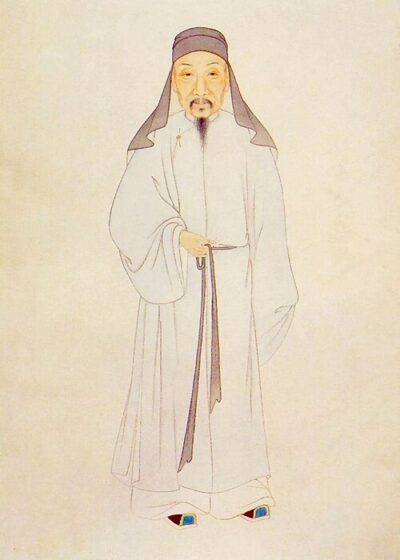
Gu Yanwu
Gu Yanwu was a Chinese philologist and geographer. Born July 15, 1613, in Kunshan. Died February 15, 1682, in Quwo County.
Facts
19 facts · 2 confirmed by two sources · 5 cited · 12 from one source
Where this comes from
Papalocal keeps its own record. It started from these sources; what each one said is kept here as it was copied, so a change on their side never changes this page by itself. Tap one to read its version.
What Wikidata says · copied November 17, 2026 · revision 2559029830
- Described as
- Chinese philologist and geographer (1613–1682)
- Other names
- Zhongqing, Ningren, Jiangshanyong, Jiangshan, Gu(3) Jishen, Guinian, Jishen, Tinglin, Tinglin xiansheng, Tao, Gu Jiang
- Born
- July 15, 1613 · 1 reference
- Died
- February 15, 1682 · 1 reference
- Born in
- Kunshan
- Died in
- Quwo County · 1 reference
- Cause of death
- horse fall
- Citizen of
- Qing dynasty · 1 reference
- Occupation
- linguist; geographer; philosopher; astronomer; student; scholar; poet · 1 reference; historian · 1 reference
- Field
- philosophy · 1 reference; philology · 1 reference; geography · 1 reference
- Father
- Gu Tongying · 1 reference
- Religion
- Confucianism
- Wikipedias with a page
- 27
Wikidata item Q1195906 (wikidata.org/wiki/Q1195906), public domain (CC0). Copied November 17, 2026.
What Wikipedia says · copied November 17, 2026 · revision 1381655178
Gu Yanwu (Chinese: 顧炎武; pinyin: Gù Yánwǔ, 1613 – 1682) was a Chinese historian, philologist, and poet. After failing to pass the civil service examination and after surviving the upheaval of the Qing conquest of the Ming dynasty, he became an itinerant scholar, traveling across much of imperial China while collecting notes for his work.
Born to a family of scholar-officials in the village of Qiandun in modern Kunshan, Jiangsu, Gu was adopted as the grandchild of his paternal uncle as an infant. He was tutored in the Chinese classics by his adoptive family, and began to pursue advancement in the imperial examination system. After the death of his adoptive grandfather, he passed preliminary examinations in 1626, but repeatedly failed to advance to the rank of juren. He abandoned the exams in 1641. He became a Ming loyalist after the Qing conquest, changing his personal name from Jiang to Yanwu ('warlike and blazing'), but declined any political position in the Ming rump state, after which he began traveling across China, likely financed by his family's landholdings in Kunshan.
The most notable of Gu's works was the Rizhilu (日知錄; 'Record of Daily Knowledge'), an edited collection of his notes on various topics, most mainly related to statecraft and historiography. He was critical of Neo-Confucianism, Buddhism, and Daoism. He criticized political centralization and reliance on law codes, arguing this ultimately reduced central authority by delegating power to clerks and officials. He advocated for historical study centered on primary sources. Only two of his works – the first edition of the Rizhilu and his phonology treatise Yinxue wushu (音學五書; 'Five Books on Phonology') – were published during his lifetime; the rest of his surviving works, including a variety of poetry, geographical texts, and notes, were published by his lone disciple Pan Lei after his death. Many of his works were lost.
Gu's thought influenced scholars throughout the Qing period, and 19th-century scholars such as He Shaoji venerated him at a Beijing temple constructed in his honor. Later, revolutionaries such as Liang Qichao praised his work, stressing his empiricism and resistance to Qing rule.
- Born, in its opening lines
- 1613
- Died, in its opening lines
- 1682
From the Wikipedia article “Gu Yanwu” (en.wikipedia.org/wiki/Gu_Yanwu), by its contributors, under CC BY-SA 4.0 (creativecommons.org/licenses/by-sa/4.0/). Copied November 17, 2026; not changed.
Confirmed Two sources agree. Cited One source, and it names where it got it. One source One source, without a reference of its own. Sources disagree The sources disagree. We show the best-supported value and keep theirs below.
