
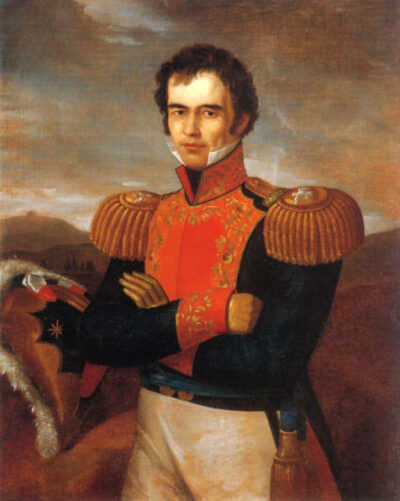
Guadalupe Victoria
Guadalupe Victoria was a first president of Mexico. Born September 29, 1786, in Tamazula de Victoria. Died March 21, 1845, in San Carlos Fortress. Positions held include President of Mexico (1824–1829) and Governor of Puebla (1834). Educated at San Ildefonso College.
Facts
18 facts · 1 confirmed by two sources · 2 cited · 14 from one source · 1 where the sources disagree
What’s different
- Died: we show March 21, 1845 (Sources disagree). Wikipedia says March 21, 1843
Where this comes from
Papalocal keeps its own record. It started from these sources; what each one said is kept here as it was copied, so a change on their side never changes this page by itself. Tap one to read its version.
What Wikidata says · copied November 16, 2026 · revision 2560346095
- Described as
- first president of Mexico (1786-1845)
- Other names
- Jose Miguel Ramon Adaucto Fernandez y Felix, José Miguel Ramón Adaucto Fernández y Félix
- Born
- September 29, 1786
- Died
- March 21, 1845
- Born in
- Tamazula de Victoria
- Died in
- San Carlos Fortress
- Buried in
- Mexico City
- Cause of death
- epilepsy
- Citizen of
- Mexico; New Spain
- Occupation
- politician · 1 reference; lawyer; soldier · 1 reference
- Positions held
- President of Mexico (1824–1829); Governor of Puebla (1834)
- Political party
- Liberal Party · 1 reference
- Education
- San Ildefonso College
- Spouse
- María Antonieta Bretón (1841–1843)
- Religion
- Catholicism
- Military rank
- year
- Wikipedias with a page
- 49
Wikidata item Q311425 (wikidata.org/wiki/Q311425), public domain (CC0). Copied November 16, 2026.
What Wikipedia says · copied November 16, 2026 · revision 1384004685
Guadalupe Victoria (Spanish pronunciation: [ɡwaðaˈlupe βikˈtoɾja]; 29 September 1786 – 21 March 1843), born José Miguel Ramón Adaucto Fernández y Félix, was a Mexican general and politician who fought for independence against the Spanish Empire in the Mexican War of Independence and after the adoption of the Constitution of 1824, was elected as the first president of the United Mexican States. He was a deputy in the Mexican Chamber of Deputies for Durango and a member of the Supreme Executive Power following the downfall of the First Mexican Empire, which was followed by the 1824 Constitution and his presidency. He later served as Governor of Puebla.
Born in Nueva Vizcaya, New Spain (now Durango), he graduated from the College of San Ildefonso with a Bachelor of Laws degree. He joined the Mexican War of Independence under general José María Morelos. During the war, he became one of the most prominent independence generals, participating in numerous battles, including the siege of Cuautla, the capture of Oaxaca, and many battles in Veracruz. In 1817, his troops deserted him, and he stayed in hiding until 1821, when the independence movement was reinvigorated by generals Vicente Guerrero and Agustín de Iturbide, and he helped re-capture Veracruz.
Victoria remained an important and popular figure in the army during the First Mexican Empire, after the Declaration of Independence, wherein de Iturbide served as Emperor Agustín. The two were at odds due to de Iturbide's suspension of congress and his refusal to install a republican form of government. Victoria joined Antonio López de Santa Anna's revolt, and de Iturbide was exiled in 1823. Victoria then served as part of the Provisional Government from 1823 to 1824, when congress ratified the Constitution of 1824, and elected Victoria as Mexico's first president.
As president, he established diplomatic relations with the United Kingdom, the United States, the Federal Republic of Central America, and Gran Colombia. He also founded the National Museum, promoted education, and ratified the border with the United States of America. He decreed the expulsion of the Spaniards remaining in the country and defeated the last Spanish stronghold in the castle of San Juan de Ulúa.
In 1829, Victoria peacefully passed the presidency to general Vicente Guerrero. Victoria was the only president to complete his full term in more than 30 years of an independent Mexico. He later served as a senator for Durango and Veracruz, governor of Puebla, and president of the senate. He negotiated an end to the Pastry War with France in 1838. He died in 1843 at the age of 56 from epilepsy in the fortress of Perote, where he was receiving medical treatment. On 8 April of the same year, it was decreed that his name would be written in golden letters in the session hall of the Chamber of Deputies.
Victoria is considered a national hero and one of the most popular presidents in the history of early Mexico. There are numerous streets, airports, schools, and cities (most notably Victoria de Durango and Ciudad Victoria) named in his honor, as is the city of Victoria, Texas, in the United States.
- Born, in its opening lines
- September 29, 1786
- Died, in its opening lines
- March 21, 1843
From the Wikipedia article “Guadalupe Victoria” (en.wikipedia.org/wiki/Guadalupe_Victoria), by its contributors, under CC BY-SA 4.0 (creativecommons.org/licenses/by-sa/4.0/). Copied November 16, 2026; not changed.
Confirmed Two sources agree. Cited One source, and it names where it got it. One source One source, without a reference of its own. Sources disagree The sources disagree. We show the best-supported value and keep theirs below.
