
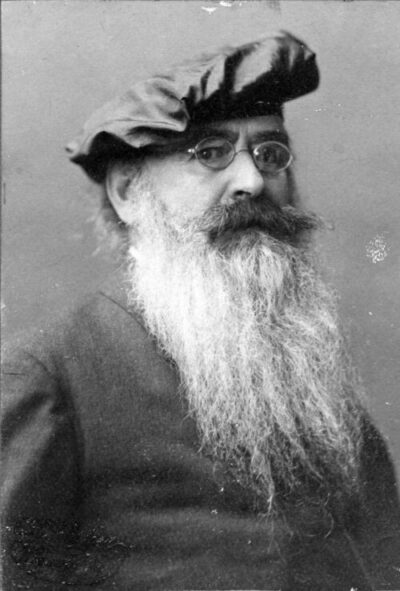
Guido von List
Guido von List was an Austrian writer. Born October 5, 1848, in Vienna. Died May 17, 1919, in Berlin.
Facts
16 facts · 2 confirmed by two sources · 4 cited · 10 from one source
Where this comes from
Papalocal keeps its own record. It started from these sources; what each one said is kept here as it was copied, so a change on their side never changes this page by itself. Tap one to read its version.
What Wikidata says · copied November 16, 2026 · revision 2569056914
- Described as
- Austrian writer (1848-1919)
- Other names
- Guido Karl Anton List
- Born
- October 5, 1848 · 3 references
- Died
- May 17, 1919
- Born in
- Vienna · 1 reference
- Died in
- Berlin · 1 reference
- Buried in
- Vienna Central Cemetery
- Cause of death
- pneumonia
- Name at birth
- Guido Karl Anton List
- Citizen of
- Austrian Empire; Austria–Hungary
- Occupation
- poet; journalist; writer · 1 reference; astrologer; philosopher · 1 reference; economist · 1 reference; anthropologist · 1 reference
- Wikipedias with a page
- 31
Wikidata item Q94040 (wikidata.org/wiki/Q94040), public domain (CC0). Copied November 16, 2026.
What Wikipedia says · copied November 16, 2026 · revision 1366470696
Guido Karl Anton List (5 October 1848 – 17 May 1919), better known as Guido von List, was an Austrian occultist, journalist, playwright, and novelist. He expounded a modern Pagan new religious movement known as Wotanism, which he claimed was the revival of the religion of the ancient German race, and which included an inner set of Ariosophical teachings that he termed Armanism.
Born to a wealthy middle-class family in Vienna, List claimed that he abandoned his family's Roman Catholic faith in childhood, instead devoting himself to the pre-Christian god Wotan. Spending much time in the Austrian countryside, he engaged in rowing, hiking, and sketching the landscape. From 1877 he began a career as a journalist, primarily authoring articles on the Austrian countryside for nationalist newspapers and magazines. In these he placed a völkisch emphasis on the folk culture and customs of rural people, believing that many of them were survivals of pre-Christian, pagan religion. He published three novels, Carnuntum (1888), Jung Diethers Heimkehr (1894), and Pipara (1895), each set among the German tribes of the Iron Age, as well as authoring several plays. During the 1890s he continued writing völkisch articles, now largely for the nationalist Ostdeutsche Rundschau newspaper, with his works taking on an antisemitic dimension halfway through that decade. In 1893, he co-founded the Literarische Donaugesellschaft literary society, and involved himself in Austria's Pan-German nationalist movement, a milieu which sought the integration of Austria into the German Empire.
During an 11-month period of blindness in 1902, List became increasingly interested in occultism, in particular coming under the influence of the Theosophical Society, resulting in an expansion of his Wotanic beliefs to incorporate Runology and the Armanen Futharkh. The popularity of his work among the völkisch and nationalist communities resulted in the establishment of a List Society in 1908; attracting significant middle and upper-class support, the Society published List's writings and included an Ariosophist inner group, the High Armanen Order, over whom List presided as Grand Master. Through these ventures he promoted the millenarian view that modern society was degenerate, but that it would be cleansed through an apocalyptic event resulting in the establishment of a new Pan-German Empire that would embrace Wotanism. After having erroneously prophesied that this empire would be established by victory for the Central Powers in World War I, List died on a visit to Berlin in 1919.
During his lifetime, List became a well-known figure among the nationalist and völkisch subcultures of Austria and Germany, influencing the work of many others operating in this milieu. His work, propagated through the List Society, influenced later völkisch groups such as the Reichshammerbund and Germanenorden, and through those exerted an influence on both the burgeoning Nazi Party, the SS and the German Faith Movement. After World War II his work continued to influence an array of Ariosophic and Heathen practitioners in Europe, Australia, and North America.
- Born, in its opening lines
- October 5, 1848
- Died, in its opening lines
- May 17, 1919
From the Wikipedia article “Guido von List” (en.wikipedia.org/wiki/Guido_von_List), by its contributors, under CC BY-SA 4.0 (creativecommons.org/licenses/by-sa/4.0/). Copied November 16, 2026; not changed.
Confirmed Two sources agree. Cited One source, and it names where it got it. One source One source, without a reference of its own. Sources disagree The sources disagree. We show the best-supported value and keep theirs below.
