
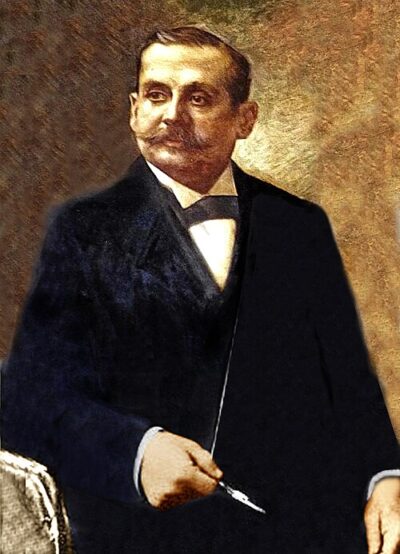
Guillermo Billinghurst
Guillermo Billinghurst was a President of Peru. Born July 27, 1851, in Arica. Died June 28, 1915, in Iquique. Positions held include President of Peru (1912–1914), president of the Senate of Peru (1896–1897) and member of the Senate of Peru (1895–1899).
Facts
18 facts · 2 confirmed by two sources · 7 cited · 9 from one source
Where this comes from
Papalocal keeps its own record. It started from these sources; what each one said is kept here as it was copied, so a change on their side never changes this page by itself. Tap one to read its version.
What Wikidata says · copied November 18, 2026 · revision 2569100395
- Described as
- President of Peru (1851-1915)
- Other names
- Guillermo Enrique Billinghurst Angulo
- Born
- July 27, 1851 · 1 reference
- Died
- June 28, 1915 · 1 reference
- Born in
- Arica · 1 reference
- Died in
- Iquique · 1 reference
- Buried in
- Presbítero Matias Maestro
- Citizen of
- Peru
- Occupation
- politician · 1 reference; businessperson; journalist · 1 reference; entrepreneur · 1 reference; writer · 1 reference
- Positions held
- President of Peru (1912–1914); president of the Senate of Peru (1896–1897); member of the Senate of Peru (1895–1899); Vice President of Peru (1895–1899); mayor of Lima (1909–1912)
- Political party
- Democrat Party
- Father
- Guillermo Eugenio Billinghurst Agrelo · 1 reference
- Wikipedias with a page
- 23
Wikidata item Q136790 (wikidata.org/wiki/Q136790), public domain (CC0). Copied November 18, 2026.
What Wikipedia says · copied November 18, 2026 · revision 1375905655
Guillermo Enrique Billinghurst Angulo (27 July 1851 – 28 June 1915) was a Peruvian politician who served as the 37th president of Peru from 1912 until his overthrow in 1914.
An Anglo-Peruvian, Billinghurst was one of the leaders of the Democratic Party (El Partido Demócrata), whose members primarily representatives of the national bourgeoisie and middle-class in the south of the country, and oriented toward the domestic market. They were opposed by the Civilistas, whose interests were directly or indirectly linked to foreign capital and were typically oriented to the foreign (export) of raw-material commodities. During his presidency, Billinghurst became embroiled in an increasingly bitter series of conflicts with Congress.
A liberal, he proposed and attempted to pass advanced social legislation in favour of the working classes. This was blocked by the conservative and oligarchic factions in the Peruvian Congress. To get around them, Billinghurst attempted to call fresh elections, which prompted these same Conservative factions to call upon the Peruvian military, led by Óscar R. Benavides, to carry out a coup d'état. As a result of the coup, which resulted in Benavides becoming president, Billinghurst was sent into exile in Chile where he died shortly thereafter.
Despite his problems with Congress and his eventual downfall, Billinghurst nevertheless succeeded in launching a program aimed at building working-class housing and establishing a School of Domestic Education to provide work for poor women. In addition, a decree was introduced during his presidency that provided an eight-hour day for port workers, while a Supreme Decree of July 1913 contained detailed measures intended to provide industrial safety in various establishments.
- Born, in its opening lines
- July 27, 1851
- Died, in its opening lines
- June 28, 1915
From the Wikipedia article “Guillermo Billinghurst” (en.wikipedia.org/wiki/Guillermo_Billinghurst), by its contributors, under CC BY-SA 4.0 (creativecommons.org/licenses/by-sa/4.0/). Copied November 18, 2026; not changed.
Confirmed Two sources agree. Cited One source, and it names where it got it. One source One source, without a reference of its own. Sources disagree The sources disagree. We show the best-supported value and keep theirs below.
