
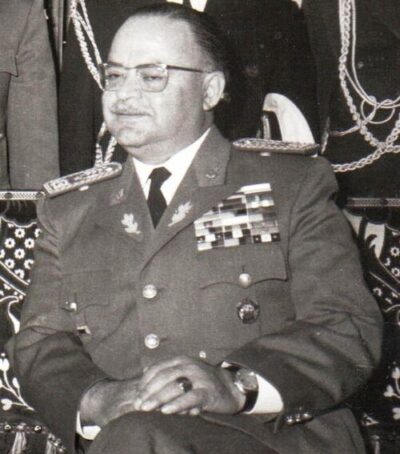
Guillermo Rodríguez is a President of Ecuador. Born November 4, 1923, in Pujilí. Educated at Western Hemisphere Institute for Security Cooperation. Awards include Grand Cross of the Order of Isabella the Catholic.
Facts
10 facts · 1 confirmed by two sources · 1 cited · 8 from one source
Where this comes from
Papalocal keeps its own record. It started from these sources; what each one said is kept here as it was copied, so a change on their side never changes this page by itself. Tap one to read its version.
What Wikidata says · copied November 17, 2026 · revision 2540332189
- Described as
- President of Ecuador (1972 - 1976)
- Other names
- Guillermo Rodriguez Lara, Rodriguez Lara
- Born
- November 4, 1923 · 2 references
- Born in
- Pujilí
- Citizen of
- Ecuador
- Occupation
- military personnel; politician
- Education
- Western Hemisphere Institute for Security Cooperation
- Awards
- Grand Cross of the Order of Isabella the Catholic (1972) · 2 references
- Spouse
- Aída Judith Leon (1953–2024)
- Military branch
- Ecuadorian Army
- Military rank
- Major
- Wikipedias with a page
- 25
Wikidata item Q728490 (wikidata.org/wiki/Q728490), public domain (CC0). Copied November 17, 2026.
What Wikipedia says · copied November 17, 2026 · revision 1383873714
Guillermo Antonio Rodríguez Lara (born 4 November 1923) is an Ecuadorian former political and military leader who was the dictator of Ecuador from 1972 to 1976. He came to power after leading the 1972 military coup against President José María Velasco Ibarra.
He characterised his government as "revolutionary and nationalistic."
- Born, in its opening lines
- November 4, 1923
From the Wikipedia article “Guillermo Rodríguez (politician)” (en.wikipedia.org/wiki/Guillermo_Rodríguez_(politician)), by its contributors, under CC BY-SA 4.0 (creativecommons.org/licenses/by-sa/4.0/). Copied November 17, 2026; not changed.
Confirmed Two sources agree. Cited One source, and it names where it got it. One source One source, without a reference of its own. Sources disagree The sources disagree. We show the best-supported value and keep theirs below.
