
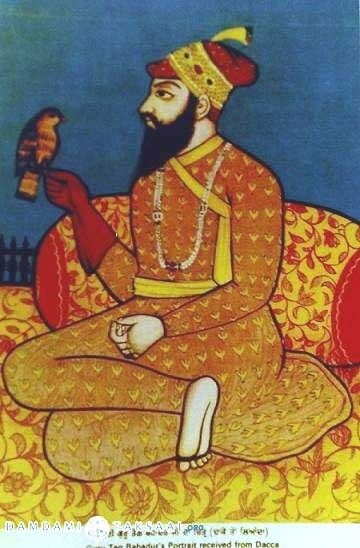
Guru Hargobind
Guru Hargobind was a Sixth Guru of Sikhism. Born June 19, 1595, in Guru ki Vadali. Died March 19, 1644, in Kiratpur Sahib. Positions held include Sikh guru.
Facts
9 facts · 1 confirmed by two sources · 0 cited · 7 from one source · 1 where the sources disagree
What’s different
- Died: we show March 19, 1644 (Sources disagree). Wikipedia says February 28, 1644
Where this comes from
Papalocal keeps its own record. It started from these sources; what each one said is kept here as it was copied, so a change on their side never changes this page by itself. Tap one to read its version.
What Wikidata says · copied November 16, 2026 · revision 2537674630
- Described as
- Sixth Guru of Sikhism
- Other names
- Saccha Paatshah, The Master of Miri Piri, The Sixth Master
- Born
- June 19, 1595
- Died
- March 19, 1644
- Born in
- Guru ki Vadali
- Died in
- Kiratpur Sahib
- Occupation
- guru
- Positions held
- Sikh guru
- Children
- Guru Tegh Bahadur; Baba Gurditta
- Father
- Guru Arjan
- Wikipedias with a page
- 31
Wikidata item Q381425 (wikidata.org/wiki/Q381425), public domain (CC0). Copied November 16, 2026.
What Wikipedia says · copied November 16, 2026 · revision 1386078472
Guru Hargobind (Gurmukhi: ਗੁਰੂ ਹਰਿਗੋਬਿੰਦ, pronunciation: [gʊɾuː ɦəɾᵊgoːbɪn̯d̯ᵊ]l 19 June 1595 – 28 February 1644) was the sixth of ten Gurus of the Sikh religion. He became Guru at the age of eleven, after the execution of his father, Guru Arjan, by the Mughal emperor Jahangir.
He spent his early life with his father at Ramdaspur (Amritsar), while his tenure as guru involved him residing in Bhai Ki Daroli, Goindwal, Kartarpur (Jalandhar), Hargobindpur, Gwalior, Lahore, and Kiratpur, with travels to Agra, Nanakmatta, Kashmir, and Malwa (Punjab).
Guru Hargobind introduced the process of militarization to Sikhism, likely as a response to his father's execution and to protect the Sikh community. He symbolized it by wearing two swords, representing the dual concept of mīrī and pīrī (temporal power and spiritual authority). In front of the Harmandir Sahib in Amritsar, Hargobind constructed the Akal Takht (the throne of the timeless one). The Akal Takht represents the highest seat of earthly authority of the Khalsa (the collective body of the Sikhs) today.
Amongst his social views, Guru Hargobind considered women to be the consciousness of mankind, promoted the lifestyle of a householder, discouraged asceticism, and promoted marriage as a pathway to self-realization. Beginning in 1606 and ending upon his death in 1644, his guruship was the second longest of all the Sikh gurus, surpassed only by Guru Nanak, whose founding guruship lasted 40 years.
- Born, in its opening lines
- June 19, 1595
- Died, in its opening lines
- February 28, 1644
From the Wikipedia article “Guru Hargobind” (en.wikipedia.org/wiki/Guru_Hargobind), by its contributors, under CC BY-SA 4.0 (creativecommons.org/licenses/by-sa/4.0/). Copied November 16, 2026; not changed.
Confirmed Two sources agree. Cited One source, and it names where it got it. One source One source, without a reference of its own. Sources disagree The sources disagree. We show the best-supported value and keep theirs below.
