
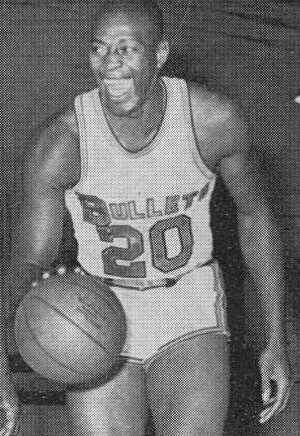
Gus Johnson
Gus Johnson was an American basketball player. Born December 13, 1938, in Akron. Died April 29, 1987, in Akron. Teams include Phoenix Suns, Indiana Pacers and Idaho Vandals men's basketball (1962–1963). Educated at University of Idaho.

Facts
16 facts · 2 confirmed by two sources · 7 cited · 7 from one source
Where this comes from
Papalocal keeps its own record. It started from these sources; what each one said is kept here as it was copied, so a change on their side never changes this page by itself. Tap one to read its version.
What Wikidata says · copied November 18, 2026 · revision 2529331479
- Described as
- American basketball player (1938-1987)
- Other names
- Gus Johnson Jr.
- Born
- December 13, 1938 · 1 reference
- Died
- April 29, 1987 · 1 reference
- Born in
- Akron
- Died in
- Akron
- Buried in
- Mount Peace Cemetery · 1 reference
- Cause of death
- brain cancer
- Citizen of
- United States
- Occupation
- basketball player · 2 references; basketball coach · 1 reference
- Education
- University of Idaho · 1 reference
- Teams
- Phoenix Suns; Indiana Pacers; Idaho Vandals men's basketball (1962–1963) · 1 reference; Boise State Broncos men's basketball · 1 reference
- Sport
- basketball · 2 references
- Height
- 1.98 m (6 ft 6 in) · 1 reference
- Wikipedias with a page
- 19
Wikidata item Q1555321 (wikidata.org/wiki/Q1555321), public domain (CC0). Copied November 18, 2026.
What Wikipedia says · copied November 18, 2026 · revision 1385705020
Gus "Honeycomb" Johnson Jr. (December 13, 1938 – April 29, 1987) was an American professional basketball player who played in the National Basketball Association (NBA) and the American Basketball Association (ABA). Often playing as a power forward, Johnson spent nine seasons with the Baltimore Bullets before he split his final campaign between the Phoenix Suns and Indiana Pacers.
In his hometown of Akron, Johnson won a city championship for Central-Hower High School and was at one point called the best player to come out of the city. Not intending to go to college, he played in the Amateur Athletic Union and industrial leagues before being recruited to play at Boise Junior College in 1961 at the age of 23. He transferred to the University of Idaho in 1962, where he averaged 19 points and 20 rebounds per game in his only season. He was selected in the second round as the 11th pick for the 1963 NBA draft by the Chicago Zephyrs (who relocated to become the Baltimore Bullets prior to the start of the 1963–64 season). He averaged 17 points with 13 rebounds to finish second in Rookie of the Year voting while being named to the All-Rookie Team. He quickly became known as a lethal inside scorer (including shattering three backboards in his NBA career) and a key defender, which saw him named to the NBA All-Star Game five times with four selections to the All-NBA Second Team and two All-Defensive First Team.
Knee injuries started to take their toll on him by 1970. He tried to play through injuries as the Bullets reached the NBA Finals in 1971 and lost in a sweep. After undergoing surgery on both knees, he was traded in June 1972 to the Phoenix Suns, playing 21 games before being released. He was picked up by the Indiana Pacers in December 1972 as a veteran presence and averaged six points in 50 games as the team advanced all the way to the ABA Finals. In his final game in Game 7, he played 13 minutes and grabbed six rebounds as the Pacers won the game, delivering Johnson's only championship. His number 25 jersey was retired by the Bullets franchise in 1986, months before his death.
Johnson would be posthumously inducted into the Naismith Memorial Basketball Hall of Fame in 2010.
- Born, in its opening lines
- December 13, 1938
- Died, in its opening lines
- April 29, 1987
From the Wikipedia article “Gus Johnson (basketball)” (en.wikipedia.org/wiki/Gus_Johnson_(basketball)), by its contributors, under CC BY-SA 4.0 (creativecommons.org/licenses/by-sa/4.0/). Copied November 18, 2026; not changed.
Confirmed Two sources agree. Cited One source, and it names where it got it. One source One source, without a reference of its own. Sources disagree The sources disagree. We show the best-supported value and keep theirs below.
