
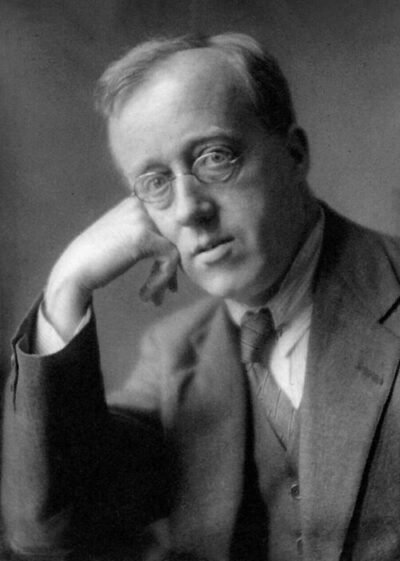
Gustav Holst
Gustav Holst was a British composer. Born September 21, 1874, in Cheltenham. Died May 25, 1934, in London. Known for The Planets and In the Bleak Midwinter. Educated at University College London and Royal College of Music. Awards include Royal Philharmonic Society Gold Medal.
Facts
26 facts · 2 confirmed by two sources · 12 cited · 12 from one source
Where this comes from
Papalocal keeps its own record. It started from these sources; what each one said is kept here as it was copied, so a change on their side never changes this page by itself. Tap one to read its version.
What Wikidata says · copied November 16, 2026 · revision 2564792108
- Described as
- British composer (1874–1934)
- Other names
- Gustav Theodore Holst, Gustavus Theodore von Holst
- Born
- September 21, 1874 · 13 references
- Died
- May 25, 1934 · 13 references
- Born in
- Cheltenham · 1 reference
- Died in
- London · 1 reference
- Buried in
- Chichester Cathedral
- Cause of death
- heart failure · 1 reference
- Name at birth
- Gustavus Theodore von Holst · 1 reference
- Citizen of
- United Kingdom of Great Britain and Ireland (–1927); United Kingdom (1927–)
- Occupation
- composer · 2 references; librettist; music teacher · 1 reference; conductor · 1 reference; music arranger · 1 reference; musician · 1 reference
- Education
- University College London; Royal College of Music · 1 reference; Pate's Grammar School
- Genre
- classical music; opera
- Instrument
- trombone · 1 reference
- Known for
- The Planets; In the Bleak Midwinter
- Awards
- Royal Philharmonic Society Gold Medal (1930)
- Children
- Imogen Holst · 1 reference
- Siblings
- Ernest Cossart
- Wikipedias with a page
- 61
Wikidata item Q200867 (wikidata.org/wiki/Q200867), public domain (CC0). Copied November 16, 2026.
What Wikipedia says · copied November 16, 2026 · revision 1384894873
Gustav Holst (born Gustavus Theodore von Holst; 21 September 1874 – 25 May 1934) was an English composer, arranger and teacher. Best known for his orchestral suite The Planets, he composed many other works across a range of genres, although none achieved comparable success. His distinctive compositional style was the product of many influences, Richard Wagner and Richard Strauss being most crucial early in his development. The subsequent inspiration of the English folksong revival of the early 20th century, and the example of such rising modern composers as Maurice Ravel, led Holst to develop and refine an individual style.
There were professional musicians in the previous three generations of Holst's family, and it was clear from his early years that he would follow the same calling. He hoped to become a pianist, but was prevented by neuritis in his right arm. Despite his father's reservations, he pursued a career as a composer, studying at the Royal College of Music under Charles Villiers Stanford. Unable to support himself by his compositions, he played the trombone professionally and later became a teacher—a great one, according to his colleague Ralph Vaughan Williams. Among other teaching activities he built up a strong tradition of performance at Morley College, where he served as musical director from 1907 until 1924, and pioneered music education for women at St Paul's Girls' School, where he taught from 1905 until his death in 1934. He was the founder of a series of Whitsun music festivals, which ran from 1916 for the remainder of his life.
Holst's works were played frequently in the early years of the 20th century, but it was not until the international success of The Planets in the years immediately after the First World War that he became a well-known figure. A shy man, he did not welcome this fame, and preferred to be left in peace to compose and teach. In his later years his uncompromising, personal style of composition struck many music lovers as too austere, and his brief popularity declined. Nevertheless, he was an important influence on a number of younger English composers, including Edmund Rubbra, Michael Tippett and Benjamin Britten. Apart from The Planets and a handful of other works, his music was generally neglected until the 1980s, when recordings of much of his output became available.
- Born, in its opening lines
- September 21, 1874
- Died, in its opening lines
- May 25, 1934
From the Wikipedia article “Gustav Holst” (en.wikipedia.org/wiki/Gustav_Holst), by its contributors, under CC BY-SA 4.0 (creativecommons.org/licenses/by-sa/4.0/). Copied November 16, 2026; not changed.
Confirmed Two sources agree. Cited One source, and it names where it got it. One source One source, without a reference of its own. Sources disagree The sources disagree. We show the best-supported value and keep theirs below.
