
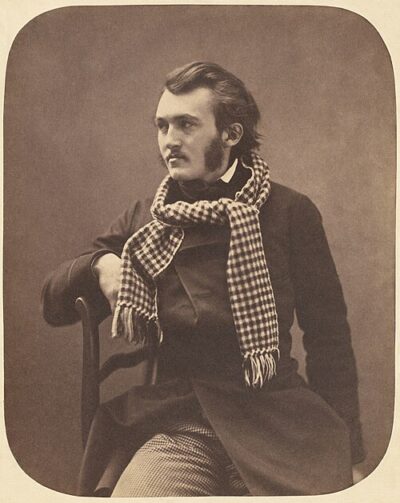
Gustave Doré
Gustave Doré was a French illustrator and painter. Born January 6, 1832, in Strasbourg. Died January 23, 1883, in 7th arrondissement of Paris. Known for Andromeda, Enigma and Les Saltimbanques. Educated at Lycée Charlemagne. Awards include Knight of the Legion of Honour, Officer of the Legion of Honour and Knight Commander of the Order of Carlos III.
Facts
36 facts · 2 confirmed by two sources · 23 cited · 10 from one source · 1 where the sources disagree
What’s different
- Buried in: we show Père Lachaise Cemetery (Sources disagree). Wikidata also lists Grave of Gustave Doré
Where this comes from
Papalocal keeps its own record. It started from these sources; what each one said is kept here as it was copied, so a change on their side never changes this page by itself. Tap one to read its version.
What Wikidata says · copied November 16, 2026 · revision 2569188386
- Described as
- French illustrator and painter (1832–1883)
- Other names
- Gustave Dore, Doré, Dore, Paul Gustave Louis Christophe Dore, G.ve Doré, Louis Christophe Paul Gustave Dore, Louis Christophe Paul Gustave Doré, Paul-Gustave Dore, Gustavo Doré, Louis Christophe Gustave Dore, Paul Gustave Doré, Louis Auguste Gustave Doré
- Born
- January 6, 1832 · 24 references
- Died
- January 23, 1883 · 26 references
- Born in
- Strasbourg · 6 references
- Died in
- 7th arrondissement of Paris · 5 references
- Buried in
- Père Lachaise Cemetery · 2 references; Grave of Gustave Doré
- Name at birth
- Paul Gustave Louis Christophe Doré
- Citizen of
- France · 1 reference
- Occupation
- painter · 5 references; illustrator · 4 references; caricaturist; comics artist · 1 reference; lithographer · 2 references; graphic artist · 1 reference; printmaker · 1 reference; sculptor · 4 references
- Worked for
- Le Charivari
- Education
- Lycée Charlemagne
- Genre
- history painting; allegory · 1 reference; religious art · 1 reference; figure · 1 reference; caricature · 1 reference; portrait · 1 reference
- Known for
- Andromeda; Enigma; Les Saltimbanques
- Awards
- Knight of the Legion of Honour (1861–) · 1 reference; Officer of the Legion of Honour (1879–) · 1 reference; Knight Commander of the Order of Carlos III (1866) · 1 reference; Knight of the Order of Saints Maurice and Lazarus (1861–) · 1 reference; Angoulême International Comics Festival Prize for Inheritance (2019) · 1 reference
- Field
- painting · 1 reference; visual arts · 1 reference; graphics · 1 reference; art of drawing · 1 reference; young adult literature · 1 reference
- Wikipedias with a page
- 79
Wikidata item Q6682 (wikidata.org/wiki/Q6682), public domain (CC0). Copied November 16, 2026.
What Wikipedia says · copied November 16, 2026 · revision 1373893702
Paul Gustave Louis Christophe Doré (UK: DOR-ay, US: dor-AY; French: [ɡystav dɔʁe]; 6 January 1832 – 23 January 1883) was a French artist. He is best known for his prolific output of wood-engravings illustrating classic literature, especially those for the Vulgate Bible and Dante's Divine Comedy. These achieved great international success, and he became renowned for printmaking, although his role was normally as the designer only; at the height of his career some 40 block-cutters were employed to cut his drawings onto the wooden printing blocks, usually also signing the image.
He created more than 10,000 illustrations, the most important of which were copied using an electrotype process using cylinder presses, allowing very large print runs to be published simultaneously in many countries.
Although Doré's work was popular with the general public during his life, it was met with mixed reviews from contemporary art critics. His work has been more widely celebrated in the centuries following his death. Among his admirers were writers H. P. Lovecraft and Théophile Gautier.
- Born, in its opening lines
- January 6, 1832
- Died, in its opening lines
- January 23, 1883
From the Wikipedia article “Gustave Doré” (en.wikipedia.org/wiki/Gustave_Doré), by its contributors, under CC BY-SA 4.0 (creativecommons.org/licenses/by-sa/4.0/). Copied November 16, 2026; not changed.
Confirmed Two sources agree. Cited One source, and it names where it got it. One source One source, without a reference of its own. Sources disagree The sources disagree. We show the best-supported value and keep theirs below.
