
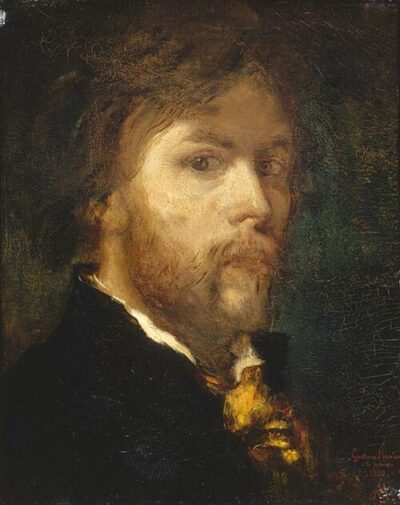
Gustave Moreau
Gustave Moreau was the 19th century French Symbolist painter. Born April 6, 1826, in Paris. Died April 18, 1898, in Paris. Known for Apollo and The Nine Muses, Oedipus and the Sphinx and Orphés. Educated at Beaux-Arts de Paris. Awards include Officer of the Legion of Honour and Knight of the Legion of Honour.
Facts
27 facts · 2 confirmed by two sources · 10 cited · 14 from one source · 1 where the sources disagree
What’s different
- Died in: we show Paris (Sources disagree). Wikidata also lists Rennes
Where this comes from
Papalocal keeps its own record. It started from these sources; what each one said is kept here as it was copied, so a change on their side never changes this page by itself. Tap one to read its version.
What Wikidata says · copied November 16, 2026 · revision 2563826353
- Described as
- 19th century French Symbolist painter (1826-1898)
- Other names
- G. Moreau, Moreau
- Born
- April 6, 1826 · 19 references
- Died
- April 18, 1898 · 17 references
- Born in
- Paris · 4 references
- Died in
- Rennes · 1 reference; Paris · 3 references
- Buried in
- Montmartre Cemetery · 1 reference
- Citizen of
- France · 1 reference
- Occupation
- sculptor; painter · 4 references; artist · 1 reference
- Worked for
- École des Beaux-Arts
- Education
- Beaux-Arts de Paris (1846–1849) · 1 reference
- Member of
- Académie des beaux-arts
- Genre
- history painting · 1 reference; religious painting · 1 reference; mythological painting · 1 reference
- Known for
- Apollo and The Nine Muses; Oedipus and the Sphinx; Orphés; Salome; Hercules and the Lernaean Hydra; The Apparition; Jupiter and Semele
- Awards
- Officer of the Legion of Honour · 1 reference; Knight of the Legion of Honour (1875–) · 1 reference
- Field
- painting · 1 reference
- Father
- Louis Moreau
- Mother
- Adele Pauline des Moutiers · 1 reference
- Wikipedias with a page
- 53
Wikidata item Q203828 (wikidata.org/wiki/Q203828), public domain (CC0). Copied November 16, 2026.
What Wikipedia says · copied November 16, 2026 · revision 1379463195
Gustave Moreau (French: [ɡystav mɔʁo]; 6 April 1826 – 18 April 1898) was a French artist and an important figure in the Symbolist movement. Jean Cassou called him "the Symbolist painter par excellence". He was an influential forerunner of symbolism in the visual arts in the 1860s, and at the height of the symbolist movement in the 1890s, he was among the most significant painters. Art historian Robert Delevoy wrote that Moreau "brought symbolist polyvalence to its highest point in Jupiter and Semele." He was a prolific artist who produced over 15,000 paintings, watercolors, and drawings. Moreau painted allegories and traditional biblical and mythological subjects favored by the fine art academies. J. K. Huysmans wrote, "Gustave Moreau has given new freshness to dreary old subjects by a talent both subtle and ample: he has taken myths worn out by the repetitions of centuries and expressed them in a language that is persuasive and lofty, mysterious and new." The female characters from the Bible and mythology that he so frequently depicted came to be regarded by many as the archetypical symbolist woman. His art (and symbolism in general) fell from favor and received little attention in the early 20th century but, beginning in the 1960s and 70s, he has come to be considered among the most paramount of symbolist painters.
Gustave Moreau was born in Paris and showed an aptitude for drawing at an early age. He received a sound education at Collège Rollin (now Collège-lycée Jacques-Decour) and traditional academic training in painting at the Ecole des Beaux-Arts. In the early 1850s he developed a close friendship/mentorship with Théodore Chassériau and had some modest success exhibiting as the Paris Salon. Chassériau's premature death in 1856 deeply affected Moreau, and he left Paris to travel in Italy from 1857 to 1859, returning with hundreds of copies and studies he made of old master paintings there. In 1864 his painting Oedipus and the Sphinx received a great deal of attention at the Paris Salon, winning a medal and establishing his reputation. He had continued success through the 1860s, gradually gaining a select group of enthusiastic and loyal admirers and collectors. Although his painting Prometheus received a medal at the Salon of 1869, criticisms in the press were severe and he did not submit paintings to the Salon again until 1876, permanently withdrawing after 1880.Moreau was decorated Officier de la Légion d'Honneur in 1883. Somewhat misanthropic, he grew increasingly reclusive in later years, although he maintained a close circle of friends. He was often reluctant to sell his work, seldom exhibited, and turned down a number of prestigious offers, including an invitation to exhibit at the Salon Les XX in Brussels (1887), rejected the post of a professor when he was elected to the Ecole des Beaux-Arts (1888), and rejected offers to decorate buildings at the Sorbonne (1891). It was only after the death of his friend Élie Delaunay in 1891 that he agreed to take over Delaunay's studio at the Ecole des Beaux-Arts. Moreau excelled as a teacher, counting Henri Matisse, Georges Rouault, and other notable artists amongst his pupils. His parents bought a townhouse in 1852 at 14 Rue de La Rochefoucauld, converting the top floor into a studio for Moreau, where he lived and worked, a bachelor, for the rest of his life, his father dying in 1862, and his mother, Adèle-Pauline in 1884. Moreau died of cancer in 1898, bequeathing the townhome and studio with nearly 1200 paintings and watercolors, and over 10,000 drawings to the State to be converted into a museum. The Musée Gustave Moreau opened to the public in 1903 and is still open today. It is by far the largest and most significant collection of his work.
- Born, in its opening lines
- April 6, 1826
- Died, in its opening lines
- April 18, 1898
From the Wikipedia article “Gustave Moreau” (en.wikipedia.org/wiki/Gustave_Moreau), by its contributors, under CC BY-SA 4.0 (creativecommons.org/licenses/by-sa/4.0/). Copied November 16, 2026; not changed.
Confirmed Two sources agree. Cited One source, and it names where it got it. One source One source, without a reference of its own. Sources disagree The sources disagree. We show the best-supported value and keep theirs below.
