
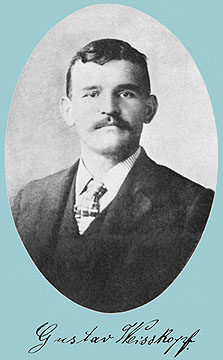
Gustave Whitehead
Gustave Whitehead was a possible first powered manned flight. Born January 1, 1874, in Leutershausen. Died October 10, 1927, in Bridgeport.
Facts
12 facts · 2 confirmed by two sources · 2 cited · 8 from one source
Where this comes from
Papalocal keeps its own record. It started from these sources; what each one said is kept here as it was copied, so a change on their side never changes this page by itself. Tap one to read its version.
What Wikidata says · copied November 15, 2026 · revision 2569046930
- Described as
- possible first powered manned flight (1874–1927)
- Other names
- Gustave Albin Whitehead, Gustav Albin Weißkopf
- Born
- January 1, 1874 · 5 references
- Died
- October 10, 1927 · 5 references
- Born in
- Leutershausen · 2 references
- Died in
- Bridgeport
- Cause of death
- myocardial infarction
- Citizen of
- Germany; United States
- Occupation
- military flight engineer; inventor; engineer; aircraft pilot · 2 references; glider pilot
- Wikipedias with a page
- 25
Wikidata item Q61361 (wikidata.org/wiki/Q61361), public domain (CC0). Copied November 15, 2026.
What Wikipedia says · copied November 15, 2026 · revision 1384904778
Gustave Albin Whitehead (born Gustav Albin Weisskopf; 1 January 1874 – 10 October 1927) was a German–American aviation pioneer. Between 1897 and 1915, he designed and built gliders, flying machines, and engines. Controversy surrounds published accounts and Whitehead's own claims that he flew a powered machine successfully several times in 1901 and 1902, predating the first flights by the Wright brothers in 1903.
Much of Whitehead's reputation rests on a newspaper article which was written as an eyewitness report and describes his powered and sustained flight in Connecticut on 14 August 1901. Over a hundred newspapers in the U.S. and around the world soon repeated information from the article. Several local newspapers also reported on other flight experiments that Whitehead made in 1901 and subsequent years. Whitehead's aircraft designs and experiments were described or mentioned in Scientific American articles and a 1904 book about industrial progress. His public profile faded after about 1915, however, and he died in relative obscurity in 1927.
In the 1930s, a magazine article and book asserted that Whitehead had made powered flights in 1901–1902, and the book includes statements from people who said that they had seen various Whitehead flights decades earlier. These published accounts triggered debate among scholars, researchers, and aviation enthusiasts. Mainstream historians have consistently dismissed the Whitehead flight claims, which Orville Wright later described as 'mythical'.
Researchers have studied and attempted to copy Whitehead's aircraft. Since the 1980s, enthusiasts in the U.S. and Germany have built and flown replicas of Whitehead's No. 21 machine using modern engines and modern propellers, and with fundamental changes to the aircraft structure and control systems.
- Born, in its opening lines
- January 1, 1874
- Died, in its opening lines
- October 10, 1927
From the Wikipedia article “Gustave Whitehead” (en.wikipedia.org/wiki/Gustave_Whitehead), by its contributors, under CC BY-SA 4.0 (creativecommons.org/licenses/by-sa/4.0/). Copied November 15, 2026; not changed.
Confirmed Two sources agree. Cited One source, and it names where it got it. One source One source, without a reference of its own. Sources disagree The sources disagree. We show the best-supported value and keep theirs below.
