
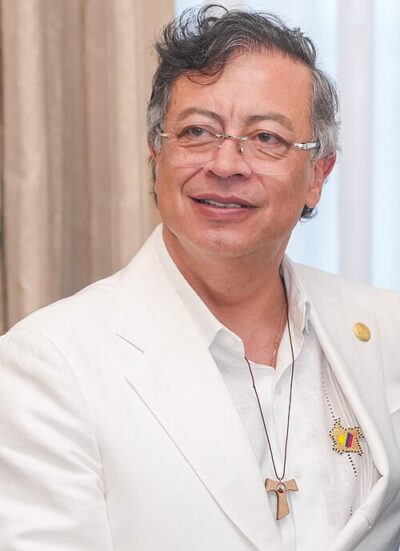
Gustavo Petro
Gustavo Petro is the 42rd President of Colombia 2022–2026. Born April 19, 1960, in Ciénaga de Oro. Positions held include member of the Senate of Colombia (2 times) (2006–2022), Mayor of Bogota (2012–2015) and member of the Chamber of Representatives of Colombia (2 times) (1991–2006). Educated at Universidad Externado de Colombia and University of Salamanca. Awards include Order of Boyacá, Order of San Carlos and honorary professor.
Facts
37 facts · 1 confirmed by two sources · 17 cited · 19 from one source
Where this comes from
Papalocal keeps its own record. It started from these sources; what each one said is kept here as it was copied, so a change on their side never changes this page by itself. Tap one to read its version.
What Wikidata says · copied November 16, 2026 · revision 2567688385
- Described as
- 42rd President of Colombia 2022–2026
- Other names
- Gustavo Petro Urrego, Petro, Gustavo Francisco Petro Urrego
- Born
- April 19, 1960 · 1 reference
- Born in
- Ciénaga de Oro · 1 reference
- Citizen of
- Colombia; Italy · 2 references
- Occupation
- politician · 1 reference; economist · 1 reference; writer; partisan (–1990) · 1 reference; environmentalist; mayor · 1 reference
- Positions held
- member of the Senate of Colombia (2 times) (2006–2022) · 1 reference; Mayor of Bogota (2012–2015) · 1 reference; member of the Chamber of Representatives of Colombia (2 times) (1991–2006); President of Colombia (2022–2026) · 1 reference; ambassador of Colombia to Belgium (1994–1996) · 1 reference; ambassador of Colombia to Luxembourg (1994–1996) · 1 reference
- Political party
- Alternative Democratic Pole (2005–2010); Humane Colombia (2011–); Alianza Democrática (1990–1997); Alternative Way (1998–2002)
- Education
- Universidad Externado de Colombia (–1982); University of Salamanca (–1995) · 1 reference; UCLouvain (–1995) · 1 reference; High School of Public Administration of Colombia. (ESAP) (–1990) · 1 reference; Pontifical Xavierian University (–1994)
- Genre
- non-fiction literature
- Awards
- Order of Boyacá (2022) · 1 reference; Order of San Carlos (2022) · 1 reference; honorary professor (2018) · 1 reference; Collar of the Order of Isabella the Catholic (2023) · 1 reference; Knight Grand Cordon with Collar of the Order of Palestine (2024)
- Spouse
- Verónica Alcocer (2000–)
- Children
- Sofía Petro; Nicolás Petro
- Religion
- liberation theology · 1 reference
- Lived in
- Bogotá · 2 references
- Website
- https://gustavopetro.co/
- Wikipedias with a page
- 75
Wikidata item Q704022 (wikidata.org/wiki/Q704022), public domain (CC0). Copied November 16, 2026.
What Wikipedia says · copied November 16, 2026 · revision 1385388707
Gustavo Francisco Petro Urrego (born 19 April 1960) is a Colombian politician and economist who served as the 35th president of Colombia from 2022 to 2026. He founded and leads the political party Historic Pact (PH) and is considered the first, and so far only, left-wing president in the recent history of Colombia.
At 17 years old, Petro joined the guerrilla group 19th of April Movement (M-19). Petro also served as a councilman in Zipaquirá. He was arrested in 1985 by the army for his affiliation with M-19, which had attacked the Palace of Justice that year and resulted in the death of 11 of the twenty-five justices in the Supreme Court of Justice of Colombia. After the peace process between the Colombian government and the M-19, he was released and later elected to the Chamber of Representatives in the 1991 parliamentary election. In the 2006 election, he was elected to the Colombian Senate as a member of the Alternative Democratic Pole (PDA). In 2009, he resigned his Senate seat to run in the 2010 Colombian presidential election, finishing fourth in the first round. Due to ideological disagreements with the leaders of the PDA, Petro founded the Humane Colombia party to compete for the mayoralty of Bogotá, and was elected mayor in 2011. He ran for president of Colombia in the 2018 election, losing the second round with 41.77% of the vote. He ran again in the 2022 presidential election, defeating Rodolfo Hernández Suárez in the second round with 50.42% of the vote.
As president, Petro pursued a progressive domestic agenda, increasing the minimum wage, strengthening the legal framework for labor protections, redistributing land to peasants, and increasing social spending. Poverty and unemployment declined during his presidency and public debt increased. His health and labor reforms stalled in Congress. His security policy, "Total Peace", which aimed to demobilize the country's remaining armed groups, has been criticized as ineffective. He is ending his term with an approval rating of about 50%, compared with a disapproval rating of 43%.
In foreign affairs, he restored diplomatic relations with Venezuela and suspended diplomatic ties with Israel over the Gaza war. Relations with the United States deteriorated sharply during Donald Trump's second term; shortly after Trump took office in January 2025, Colombia and the US had a dispute over deportation flights and in September, the US revoked Petro's US visa. The U.S. Treasury in October 2025 added Petro, his wife, his son, and his interior minister to its Specially Designated Nationals (SDN) list, alleging involvement in the global illicit drug trade.
For the 2026 Colombian presidential election, Petro was constitutionally barred from seeking a second term. He instead endorsed fellow Historic Pact Senator Iván Cepeda to be his successor. In what became the closest election in Colombia's history, Cepeda was narrowly defeated by Abelardo de la Espriella, who succeeded Petro as president of Colombia on August 7, 2026. Petro condemned foreign interference in this election. Hours later Petro acknowledged the results, announcing that his administration would begin the formal handover process.
- Born, in its opening lines
- April 19, 1960
From the Wikipedia article “Gustavo Petro” (en.wikipedia.org/wiki/Gustavo_Petro), by its contributors, under CC BY-SA 4.0 (creativecommons.org/licenses/by-sa/4.0/). Copied November 16, 2026; not changed.
Confirmed Two sources agree. Cited One source, and it names where it got it. One source One source, without a reference of its own. Sources disagree The sources disagree. We show the best-supported value and keep theirs below.
