
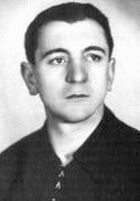
Gusztáv Sebes
Gusztáv Sebes was a Hungarian footballer. Born January 22, 1906, in Budapest. Died January 30, 1986, in Budapest. Teams include MTK Budapest FC (2 times) (1927–1945), Hungary men's national football team (1936) and Vasas FC (1920–1924).
Facts
13 facts · 2 confirmed by two sources · 2 cited · 9 from one source
Where this comes from
Papalocal keeps its own record. It started from these sources; what each one said is kept here as it was copied, so a change on their side never changes this page by itself. Tap one to read its version.
What Wikidata says · copied November 16, 2026 · revision 2555357211
- Described as
- Hungarian footballer (1906–1986)
- Other names
- Gusztav Sebes
- Born
- January 22, 1906 · 1 reference
- Died
- January 30, 1986
- Born in
- Budapest
- Died in
- Budapest
- Buried in
- Budafok Cemetery · 1 reference
- Citizen of
- Hungary
- Occupation
- association football player; association football coach · 1 reference; sports official
- Teams
- MTK Budapest FC (2 times) (1927–1945); Hungary men's national football team (1936); Vasas FC (1920–1924)
- Sport
- association football
- Wikipedias with a page
- 29
Wikidata item Q381770 (wikidata.org/wiki/Q381770), public domain (CC0). Copied November 16, 2026.
What Wikipedia says · copied November 16, 2026 · revision 1381394836
Gusztáv Sebes (born Gusztáv Scharenpeck; 22 January 1906 – 30 January 1986) was a Hungarian footballer, who played as a midfielder, and became a well-known coach later. With the title of Deputy Minister of Sport, he coached the Hungarian team known as the Mighty Magyars in the 1950s. Among the players in the team were Ferenc Puskás, Zoltán Czibor, Sándor Kocsis, József Bozsik, and Nándor Hidegkuti. Together with Béla Guttmann and Márton Bukovi, he formed a triumvirate of radical Hungarian coaches who pioneered the 4–2–4 formation.
Sebes advocated what he referred to as socialist football, an early version of Total Football, with every player pulling equal weight and able to play in all positions. Under Sebes, Hungary went unbeaten for 22 consecutive matches. During this run, Hungary became Olympic Champions in 1952 and Central European Champions in 1953. They also twice defeated England, 6–3 in 1953 and 7–1 in 1954, and finished as runners-up in the 1954 FIFA World Cup. Defeat in the final marked the beginning of the end for Sebes. Following this defeat, Hungary embarked on an 18-game unbeaten run that came to an end on 19 February 1956, when they lost 3–1 to Turkey. Despite the winning streak, Sebes was sacked after a 5–4 defeat against Belgium on 3 June 1956. He remained active in football throughout his life, working as an administrator and holding coaching positions at Újpesti Dózsa SC, Budapest Honvéd SE, and Diósgyőri VTK.
Gusztáv Sebes, then Hungary's undersecretary of sports and vice-president of UEFA, participated in its meeting at the beginning of April 1955 with the aim of studying the proposal to create a European Cup where the best teams on the continent would participate. The initiative was promoted by the French sports newspaper L'Équipe, by its director at the time Gabriel Hanot together with his colleague Jacques Ferran, and with the support of the president of Real Madrid Santiago Bernabéu, as well as Sebes.
- Born, in its opening lines
- January 22, 1906
- Died, in its opening lines
- January 30, 1986
From the Wikipedia article “Gusztáv Sebes” (en.wikipedia.org/wiki/Gusztáv_Sebes), by its contributors, under CC BY-SA 4.0 (creativecommons.org/licenses/by-sa/4.0/). Copied November 16, 2026; not changed.
Confirmed Two sources agree. Cited One source, and it names where it got it. One source One source, without a reference of its own. Sources disagree The sources disagree. We show the best-supported value and keep theirs below.
