
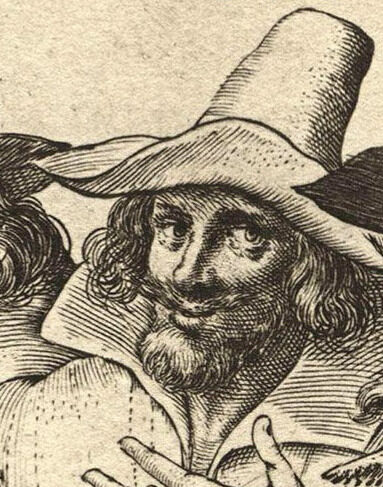
Guy Fawkes
Guy Fawkes was an English member of the Gunpowder Plot of 1605. Born April 13, 1570, in York. Died January 31, 1606, in Westminster. Educated at St Peter's School.
Facts
16 facts · 2 confirmed by two sources · 9 cited · 5 from one source
Where this comes from
Papalocal keeps its own record. It started from these sources; what each one said is kept here as it was copied, so a change on their side never changes this page by itself. Tap one to read its version.
What Wikidata says · copied November 16, 2026 · revision 2569127783
- Described as
- English member of the Gunpowder Plot of 1605
- Other names
- John Johnson, Guido Fawkes
- Born
- April 13, 1570 · 1 reference
- Died
- January 31, 1606 · 2 references
- Born in
- York · 2 references
- Died in
- Westminster · 2 references
- Cause of death
- cervical fracture · 1 reference
- Citizen of
- Kingdom of England · 1 reference
- Occupation
- military personnel; soldier · 1 reference; military officer · 1 reference; politician · 1 reference
- Education
- St Peter's School
- Father
- Edward Fawkes · 1 reference
- Mother
- Edith Jackson (Blake) · 1 reference
- Religion
- Catholicism · 1 reference
- Military branch
- Army of Flanders
- Military rank
- alférez
- Wikipedias with a page
- 78
Wikidata item Q13898 (wikidata.org/wiki/Q13898), public domain (CC0). Copied November 16, 2026.
What Wikipedia says · copied November 16, 2026 · revision 1384185070
Guy Fawkes (; 13 April 1570 – 31 January 1606), also known as Guido Fawkes while fighting for the Spanish, was a member of a group of provincial English Catholics involved in the failed Gunpowder Plot of 1605. He was born and educated in York; his father died when Fawkes was eight years old, after which his mother married a recusant Catholic.
Fawkes converted to Catholicism and left for mainland Europe, where he fought for Catholic Spain in the Eighty Years' War against Protestant Dutch reformers in the Low Countries. He travelled to Spain to seek support for a Catholic rebellion in England without success. He later met Thomas Wintour, with whom he returned to England. Wintour introduced him to Robert Catesby, who planned to assassinate King James I and restore a Catholic monarch to the throne. The plotters leased an undercroft beneath the House of Lords; Fawkes was placed in charge of the gunpowder that they stockpiled there. The authorities were prompted by an anonymous letter to search Westminster Palace during the early hours of 5 November, and they found Fawkes guarding the explosives. He was questioned and tortured over the next few days and confessed to wanting to blow up the House of Lords.
Fawkes was sentenced to be hanged, drawn and quartered. However, at his execution on 31 January, he died when his neck was broken as he was hanged, with some sources claiming that he deliberately jumped to make this happen; he thus avoided the agony of his sentence. He became synonymous with the Gunpowder Plot, the failure of which has been commemorated in the UK as Guy Fawkes Night since 5 November 1605, when his effigy is traditionally burned on a bonfire, commonly accompanied by fireworks.
- Born, in its opening lines
- April 13, 1570
- Died, in its opening lines
- January 31, 1606
From the Wikipedia article “Guy Fawkes” (en.wikipedia.org/wiki/Guy_Fawkes), by its contributors, under CC BY-SA 4.0 (creativecommons.org/licenses/by-sa/4.0/). Copied November 16, 2026; not changed.
Confirmed Two sources agree. Cited One source, and it names where it got it. One source One source, without a reference of its own. Sources disagree The sources disagree. We show the best-supported value and keep theirs below.
