
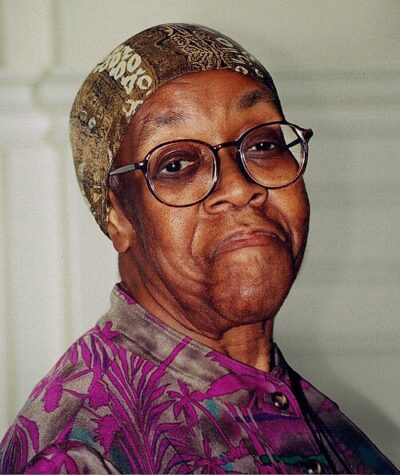
Gwendolyn Brooks
Gwendolyn Brooks was an American writer. Born June 7, 1917, in Topeka. Died December 3, 2000, in Chicago. Known for Jump Bad: a New Chicago Anthology. Educated at Englewood Technical Prep Academy and Hyde Park Academy High School. Awards include Guggenheim Fellowship, National Medal of Arts and National Women's Hall of Fame.
Facts
52 facts · 2 confirmed by two sources · 36 cited · 14 from one source
Where this comes from
Papalocal keeps its own record. It started from these sources; what each one said is kept here as it was copied, so a change on their side never changes this page by itself. Tap one to read its version.
What Wikidata says · copied November 13, 2026 · revision 2564024286
- Described as
- American writer (1917–2000)
- Other names
- Gwendolyn Elizabeth Brooks
- Born
- June 7, 1917 · 10 references
- Died
- December 3, 2000 · 11 references
- Born in
- Topeka · 4 references
- Died in
- Chicago · 3 references
- Buried in
- Lincoln Cemetery
- Cause of death
- cancer
- Name at birth
- Gwendolyn Elizabeth Brooks · 1 reference
- Citizen of
- United States
- Occupation
- poet · 4 references; writer · 2 references; novelist · 2 references; teacher · 2 references; university teacher · 1 reference
- Worked for
- Chicago State University; NAACP · 1 reference; Columbia College Chicago (1963–) · 2 references; Northeastern Illinois University · 1 reference; Elmhurst University · 1 reference; Columbia University · 1 reference; University of Wisconsin–Madison · 1 reference
- Education
- Englewood Technical Prep Academy (–1934) · 2 references; Hyde Park Academy High School · 1 reference; Kennedy–King College (–1936) · 1 reference; Wendell Phillips Academy High School · 1 reference
- Member of
- American Academy of Arts and Letters (1976–) · 1 reference
- Known for
- Jump Bad: a New Chicago Anthology
- Awards
- Guggenheim Fellowship (1946) · 1 reference; National Medal of Arts · 1 reference; National Women's Hall of Fame (1988) · 1 reference; Pulitzer Prize for Poetry (1950) · 1 reference; Library of Congress Living Legend (2000–) · 1 reference; Langston Hughes Medal (1979) · 1 reference; Anisfield-Wolf Book Awards (1969); United States Poet Laureate (1985); Robert Frost Medal (1989) · 1 reference; Jefferson Lecture (1994); Eunice Tietjens Memorial Prize (1949) · 1 reference; Black Literary Hall of Fame (1998) · 1 reference; Kuumba Liberation Award (1969); Fellowship of the Academy of American Poets (1999) · 1 reference; Shelley Memorial Award (1976) · 1 reference
- Field
- poetry · 1 reference; fiction writing · 1 reference
- Spouse
- Henry Blakely (1938–) · 2 references
- Children
- Nora Brooks Blakely · 1 reference
- Mother
- Keziah C. Brooks · 1 reference
- Siblings
- Raymond Brooks · 1 reference
- Lived in
- Illinois; South Side (–2000) · 1 reference; Topeka; Michigan Boulevard Garden Apartments; Chicago (1917–) · 1 reference
- Wikipedias with a page
- 45
Wikidata item Q270715 (wikidata.org/wiki/Q270715), public domain (CC0). Copied November 13, 2026.
What Wikipedia says · copied November 13, 2026 · revision 1381033533
Gwendolyn Elizabeth Brooks (June 7, 1917 – December 3, 2000) was an American poet, author, and teacher. Her work often dealt with the personal celebrations and struggles of ordinary people in her community. She won the Pulitzer Prize for Poetry on May 1, 1950 for Annie Allen, making her the first African American to receive a Pulitzer Prize.
Throughout her prolific writing career, Brooks received many more honors. A lifelong resident of Chicago, she was appointed Poet Laureate of Illinois in 1968, a position she held until her death 32 years later. She was also named the U.S. Poet Laureate for the 1985–86 term. In 1976, she became the first African-American woman inducted into the American Academy of Arts and Letters.
- Born, in its opening lines
- June 7, 1917
- Died, in its opening lines
- December 3, 2000
From the Wikipedia article “Gwendolyn Brooks” (en.wikipedia.org/wiki/Gwendolyn_Brooks), by its contributors, under CC BY-SA 4.0 (creativecommons.org/licenses/by-sa/4.0/). Copied November 13, 2026; not changed.
Confirmed Two sources agree. Cited One source, and it names where it got it. One source One source, without a reference of its own. Sources disagree The sources disagree. We show the best-supported value and keep theirs below.
