
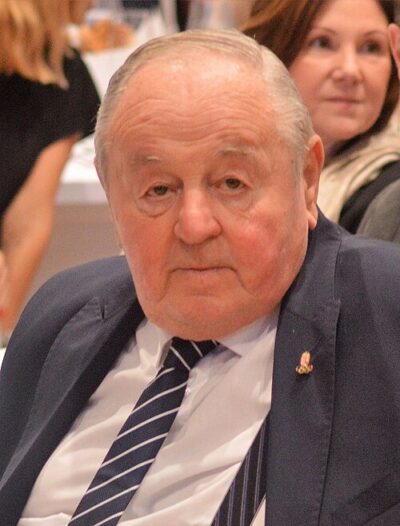
György Kárpáti
György Kárpáti was a Hungarian water polo player and coach. Born June 23, 1935, in Budapest. Died June 17, 2020, in Budapest. Teams include Ferencvárosi TC. Awards include honorary citizen of Budapest.
Facts
15 facts · 2 confirmed by two sources · 5 cited · 8 from one source
Where this comes from
Papalocal keeps its own record. It started from these sources; what each one said is kept here as it was copied, so a change on their side never changes this page by itself. Tap one to read its version.
What Wikidata says · copied November 17, 2026 · revision 2549534046
- Described as
- Hungarian water polo player and coach (1935–2020)
- Born
- June 23, 1935
- Died
- June 17, 2020
- Born in
- Budapest
- Died in
- Budapest · 1 reference
- Buried in
- Farkasréti Cemetery · 1 reference
- Citizen of
- Hungary
- Occupation
- water polo player; water polo coach · 1 reference; informant (1962–1987) · 1 reference
- Member of
- International Swimming Hall of Fame (1982) · 1 reference
- Teams
- Ferencvárosi TC
- Sport
- water polo
- Awards
- honorary citizen of Budapest (2008)
- Spouse
- Éva Tímár · 1 reference
- Height
- 1.67 m (5 ft 6 in)
- Wikipedias with a page
- 25
Wikidata item Q610137 (wikidata.org/wiki/Q610137), public domain (CC0). Copied November 17, 2026.
What Wikipedia says · copied November 17, 2026 · revision 1361685632
György Kárpáti (23 June 1935 – 17 June 2020) was a Hungarian water polo player who competed at the 1952 Summer Olympics, 1956 Summer Olympics, 1960 Summer Olympics, and 1964 Summer Olympics. He is one of 12 male athletes who won four or more Olympic medals in water polo, and one of 13 male athletes who won three Olympic gold medals in water polo.
- Born, in its opening lines
- June 23, 1935
- Died, in its opening lines
- June 17, 2020
From the Wikipedia article “György Kárpáti” (en.wikipedia.org/wiki/György_Kárpáti), by its contributors, under CC BY-SA 4.0 (creativecommons.org/licenses/by-sa/4.0/). Copied November 17, 2026; not changed.
Confirmed Two sources agree. Cited One source, and it names where it got it. One source One source, without a reference of its own. Sources disagree The sources disagree. We show the best-supported value and keep theirs below.
