
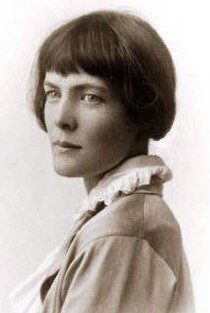
H.D.
H.D. was an American Imagist poet. Born September 10, 1886, in Bethlehem. Died September 27, 1961. Educated at Bryn Mawr College and Friends' Central School.
Facts
17 facts · 2 confirmed by two sources · 5 cited · 10 from one source
Where this comes from
Papalocal keeps its own record. It started from these sources; what each one said is kept here as it was copied, so a change on their side never changes this page by itself. Tap one to read its version.
What Wikidata says · copied November 13, 2026 · revision 2565753066
- Described as
- American Imagist poet (1886–1961)
- Other names
- Hilda Doolittle-Aldington, Hilda Doolittle, H. D., Hilda “H.D.” Doolittle Aldington, Delia Alton, Hilda Doolittle Aldington
- Born
- September 10, 1886 · 10 references
- Died
- September 27, 1961 · 8 references
- Born in
- Bethlehem · 2 references
- Buried in
- Nisky Hill Cemetery
- Citizen of
- United States
- Occupation
- poet · 1 reference; writer · 2 references; autobiographer; actor · 1 reference; novelist
- Education
- Bryn Mawr College; Friends' Central School
- Field
- poetry
- Spouse
- Richard Aldington (1913–1938)
- Children
- Perdita Aldington
- Father
- Charles Leander Doolittle · 1 reference
- Mother
- Helen Eugenia Wolle · 1 reference
- Wikipedias with a page
- 45
Wikidata item Q236469 (wikidata.org/wiki/Q236469), public domain (CC0). Copied November 13, 2026.
What Wikipedia says · copied November 13, 2026 · revision 1372366860
Hilda Doolittle (September 10, 1886 – September 27, 1961) was an American modernist poet, novelist, and memoirist who wrote under the name H.D. throughout her life. Her career began in 1911 after she moved to London and co-founded the avant-garde Imagist group of poets with American expatriate poet and critic Ezra Pound. During this early period, her minimalist free verse poems depicting Classical motifs drew international attention. Eventually distancing herself from the Imagist movement, she experimented with a wider variety of forms, including fiction, memoir, and verse drama. Reflecting the trauma she experienced in London during the Blitz, H.D.'s poetic style from World War II until her death pivoted towards complex long poems on esoteric and pacifist themes.
H.D. was born in Bethlehem, Pennsylvania, to wealthy and educated parents. Discovering her bisexuality, she had her first same-sex relationship while attending Bryn Mawr College between 1904 and 1906. After years of friendship, H.D. became engaged to Pound and followed him to London in 1911, where he championed her work. Their relationship soon fell apart, however, and H.D. instead married the Imagist poet Richard Aldington in 1913. In 1918, she met the novelist Bryher, who became her romantic partner and close friend until her death. An associate literary editor of the Egoist journal between 1916 and 1917, H.D. was published by The English Review and The Transatlantic Review. During World War I, both her brother and father died, and she separated from Aldington. She was treated by Sigmund Freud during the 1930s, as she sought to address and understand both her war trauma and bisexuality.
H.D. was keenly interested in Ancient Greek literature and published numerous Greek translations. Her poems routinely drew from Greek mythology and classical poets, from her earliest Imagist lyrics which depicted natural landscapes using Hellenistic motifs, to her 1950s long poem Helen in Egypt which reinterpreted the myth of the Trojan War. Raised Moravian by her family, and first introduced to occult and esoteric religious ideas by Pound in her youth, H.D. gradually developed a unique syncretic spiritual worldview. H.D.'s spiritual devotion intensified during and after World War II, and her syncretic ideas became the central focus of her later writing.
While H.D. wrote in a wide range of genres and modes over her career, during her lifetime she was known almost exclusively for her early Imagist poems. Following a reappraisal by feminist critics in the 1970s and 1980s, the significance of her late long poems and prose works was increasingly recognized, and she has come to be understood as a central figure in the history of modernist literature.
- Born, in its opening lines
- September 10, 1886
- Died, in its opening lines
- September 27, 1961
From the Wikipedia article “H.D.” (en.wikipedia.org/wiki/H.D.), by its contributors, under CC BY-SA 4.0 (creativecommons.org/licenses/by-sa/4.0/). Copied November 13, 2026; not changed.
Confirmed Two sources agree. Cited One source, and it names where it got it. One source One source, without a reference of its own. Sources disagree The sources disagree. We show the best-supported value and keep theirs below.
