
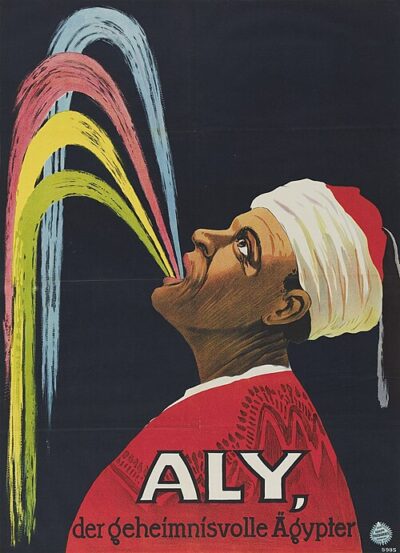
Hadji Ali was an Egyptian vaudeville performance artist. Born 1888. Died November 5, 1937, in Wolverhampton.
Facts
10 facts · 0 confirmed by two sources · 0 cited · 10 from one source
Where this comes from
Papalocal keeps its own record. It started from these sources; what each one said is kept here as it was copied, so a change on their side never changes this page by itself. Tap one to read its version.
What Wikidata says · copied November 18, 2026 · revision 2529352014
- Described as
- Egyptian vaudeville performance artist
- Born
- 1888
- Died
- November 5, 1937
- Died in
- Wolverhampton
- Cause of death
- heart failure
- Citizen of
- Ottoman Empire (–1914); Sultanate of Egypt (1914–1922); Kingdom of Egypt (1922–1937); United States
- Occupation
- vaudeville performer; regurgitation performer
- Wikipedias with a page
- 19
Wikidata item Q2590131 (wikidata.org/wiki/Q2590131), public domain (CC0). Copied November 18, 2026.
What Wikipedia says · copied November 18, 2026 · revision 1380081417
Hadji Ali (Arabic: حاج علي; c. 1888–1892 – November 5, 1937) was a vaudeville performance artist, thought to be of Egyptian descent, who was famous for acts of controlled regurgitation. His best-known feats included water spouting, smoke swallowing, and swallowing nuts and handkerchiefs before disgorging them in an order chosen by the audience. Ali's most famous stunt, and the highlight of his act, was drinking copious amounts of water followed by kerosene, and then acting by turns as a human flamethrower and fire extinguisher as he expelled the two liquids onto a theatrical prop. While these stunts were performed, a panel of audience members was invited to watch the show up close to verify that no trickery was employed.
Although he never gained wide fame, Ali had a dedicated following on the vaudeville circuit in the United States. He performed for heads of state including Tsar Nicholas II of Russia. Judy Garland named him her favorite vaudevillian and David Blaine identified Ali as his favorite magician. Portions of his act were captured in the short film Strange as It Seems (1930) and in Politiquerias (1931), the Spanish-language version of Laurel and Hardy's Chickens Come Home. Two documentaries contain footage of Ali taken from Politiquerias: 1977's Gizmo!, and 1999's Vaudeville. Ali's unusual gastric abilities led to rumors that the Rockefeller Institute had offered a large sum of money to obtain his stomach post-mortem. After he died in England, his body was offered to Johns Hopkins University for study, though the offer was declined.
From the Wikipedia article “Hadji Ali” (en.wikipedia.org/wiki/Hadji_Ali), by its contributors, under CC BY-SA 4.0 (creativecommons.org/licenses/by-sa/4.0/). Copied November 18, 2026; not changed.
Confirmed Two sources agree. Cited One source, and it names where it got it. One source One source, without a reference of its own. Sources disagree The sources disagree. We show the best-supported value and keep theirs below.
