
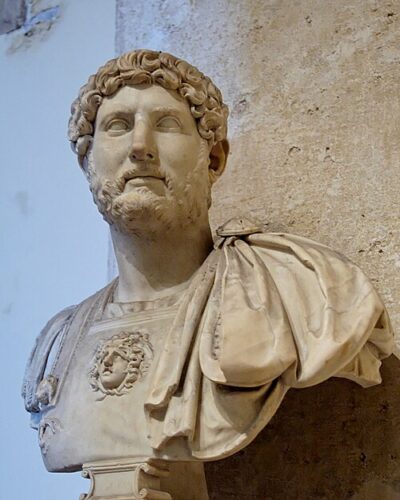
Hadrian
Hadrian was the 14th Roman Emperor. Born January 24, 76, in Italica. Died July 10, 138, in Baia. Positions held include Roman emperor (117–138), ancient Roman senator and tribune of the plebs.
Facts
27 facts · 0 confirmed by two sources · 6 cited · 19 from one source · 2 where the sources disagree
What’s different
- Born: we show January 24, 76 (Sources disagree). Wikipedia says July 10, 138
- Father: we show Publius Aelius Hadrianus Afer (Sources disagree). Wikidata also lists Trajan
Where this comes from
Papalocal keeps its own record. It started from these sources; what each one said is kept here as it was copied, so a change on their side never changes this page by itself. Tap one to read its version.
What Wikidata says · copied November 16, 2026 · revision 2565594776
- Described as
- 14th Roman Emperor (117–138)
- Other names
- Emperor of Rome Adrian, Caesar Traianus Hadrianus Augustus, Emperor of Rome Hadrian, Adrian, Hadrianus, Caesar Publius Aelius Traianus Hadrianus Buccellanus Augustus, Publius Aelius Hadrianus Buccellanus, Publius Aelius Traianus Hadrianus Augustus, Emperor Publius Aelius Hadrianus, Emperor Hadrian, Publius Aelius Hadrianus
- Born
- January 24, 76 · 2 references
- Died
- July 10, 138 · 2 references
- Born in
- Italica
- Died in
- Baia · 1 reference
- Buried in
- Castel Sant'Angelo
- Cause of death
- heart failure
- Name at birth
- Publius Aelius Hadrianus
- Citizen of
- Ancient Rome
- Occupation
- sovereign; politician; military personnel · 1 reference; poet · 1 reference
- Positions held
- Roman emperor (117–138); ancient Roman senator; tribune of the plebs; eponymous archon (112–113); tribunus militum laticlavius legionis V Macedonicae · 1 reference; legatus Augusti pro praetore Syriae (117) · 1 reference
- Spouse
- Vibia Sabina · 1 reference
- Children
- Lucius Aelius Caesar · 1 reference; Antoninus Pius
- Father
- Publius Aelius Hadrianus Afer; Trajan
- Mother
- Domitia Paulina · 1 reference
- Siblings
- Aelia Domitia Paulina · 1 reference
- Religion
- ancient Roman religion
- Military rank
- legatus; military tribune
- Wikipedias with a page
- 113
Wikidata item Q1427 (wikidata.org/wiki/Q1427), public domain (CC0). Copied November 16, 2026.
What Wikipedia says · copied November 16, 2026 · revision 1384073914
Hadrian ( HAY-dree-ən; born Publius Aelius Hadrianus, 24 January 76 – 10 July 138) was the Roman emperor from 117 to 138. His form of address as Roman emperor was Imperator Caesar Traianus Hadrianus Augustus. Hadrian was born in Italica, in the present-day Andalusian province of Seville in southern Spain, an Italic settlement in Hispania Baetica; his gens Aelia came from the town of Hadria in central Italy. He was a member of the Nerva–Antonine dynasty.
Early in his political career, Hadrian married Vibia Sabina, grandniece of the ruling emperor, Trajan, and his second cousin once removed. The marriage and Hadrian's later succession as emperor were probably promoted by Trajan's wife Pompeia Plotina. Soon after his succession, Hadrian had four leading senators unlawfully put to death, most likely because they seemed to threaten the security of his reign; this earned him the senate's lifelong enmity. He earned further disapproval by abandoning Trajan's expansionist policies and territorial gains in Mesopotamia, Assyria, Armenia, and parts of Dacia. Hadrian preferred to invest in the development of stable, defensible borders and the unification of the Roman empire's disparate peoples and subjects. He was a promoter of philhellenism.
Hadrian energetically pursued his Imperial ideals and personal interests. He visited almost every province of the Empire, and indulged a preference for direct intervention in imperial and provincial affairs, especially building projects. He is particularly known for building Hadrian's Wall, which marked the northern limit of Britannia. In Rome, he rebuilt the Pantheon and constructed the vast Temple of Venus and Roma, as well as the Villa Adriana in Tivoli. In Egypt, he may have rebuilt the Serapeum of Alexandria. As an ardent admirer of Greek culture, he promoted Athens as the cultural capital of the Empire. His intense relationship with a Greek youth, Antinous and the latter's untimely death led Hadrian to establish a widespread, popular cult. Late in Hadrian's reign, he suppressed the Bar Kokhba Revolt, which he saw as a failure of his universal project and philhellenic ideal.
Hadrian's last years were marred by chronic illness. His marriage had been both unhappy and childless. In 138, he adopted Antoninus Pius and nominated him as a successor, on condition that Antoninus adopt Marcus Aurelius and Lucius Verus as his heirs. Hadrian died the same year at Baiae, and Antoninus had him deified, despite opposition from the Senate. Later historians counted him as one of Rome's so-called "Five Good Emperors" and as a benevolent autocrat. His Senate found him remote and authoritarian. He has been described as enigmatic and contradictory, with a capacity for great generosity and extreme cruelty and driven by insatiable curiosity, conceit, and ambition.
- Born, in its opening lines
- July 10, 138
From the Wikipedia article “Hadrian” (en.wikipedia.org/wiki/Hadrian), by its contributors, under CC BY-SA 4.0 (creativecommons.org/licenses/by-sa/4.0/). Copied November 16, 2026; not changed.
Confirmed Two sources agree. Cited One source, and it names where it got it. One source One source, without a reference of its own. Sources disagree The sources disagree. We show the best-supported value and keep theirs below.
