
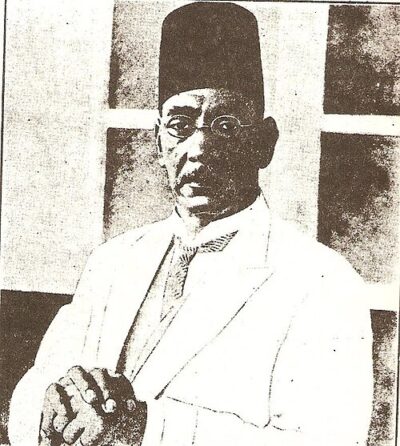
Hafiz Ibrahim was an Egyptian poet. Born 1871, in Asyut Governorate. Died July 31, 1932, in Cairo.
Facts
14 facts · 2 confirmed by two sources · 4 cited · 8 from one source
What’s different
- Born: we show 1871 (Confirmed). Wikidata also lists February 24, 1872
- Died: we show July 31, 1932 (Confirmed). Wikidata also lists 1932
Where this comes from
Papalocal keeps its own record. It started from these sources; what each one said is kept here as it was copied, so a change on their side never changes this page by itself. Tap one to read its version.
What Wikidata says · copied November 18, 2026 · revision 2563084907
- Described as
- Egyptian poet
- Other names
- Hafez Ibrahim
- Born
- February 24, 1872; 1871 · 1 reference
- Died
- July 31, 1932; 1932 · 1 reference
- Born in
- Asyut Governorate
- Died in
- Cairo · 1 reference
- Citizen of
- Khedivate of Egypt; Sultanate of Egypt; Kingdom of Egypt
- Occupation
- poet · 2 references; translator · 1 reference; writer · 1 reference; film editor · 1 reference; academic · 1 reference
- Member of
- Arab Academy of Damascus
- Field
- poetry · 1 reference
- Wikipedias with a page
- 20
Wikidata item Q2993475 (wikidata.org/wiki/Q2993475), public domain (CC0). Copied November 18, 2026.
What Wikipedia says · copied November 18, 2026 · revision 1385627492
Mohamed Hafez Ibrahim (Arabic: محمد حافظ إبراهيم, ALA-LC: Muḥammad Ḥāfiẓ Ibrāhīm; 1871–1932) was an Egyptian poet of the early 20th century. He was dubbed the "Poet of the Nile", and sometimes the "Poet of the People", for his political commitment to the poor. His poetry took on the concerns of the majority of ordinary Egyptians, including women’s rights, poverty, education, as well as his criticism of the British Empire and foreign occupation.
He was one of several Egyptian poets who revived Classical Arabic poetry during the latter half of the 19th century. While still using the classical Arabic system of meter and rhyme, these poets wrote to express new ideas and feelings unknown to the classical poets. Hafez is noted for writing poems on political and social commentary.
- Born, in its opening lines
- 1871
- Died, in its opening lines
- 1932
From the Wikipedia article “Hafez Ibrahim” (en.wikipedia.org/wiki/Hafez_Ibrahim), by its contributors, under CC BY-SA 4.0 (creativecommons.org/licenses/by-sa/4.0/). Copied November 18, 2026; not changed.
Confirmed Two sources agree. Cited One source, and it names where it got it. One source One source, without a reference of its own. Sources disagree The sources disagree. We show the best-supported value and keep theirs below.
