
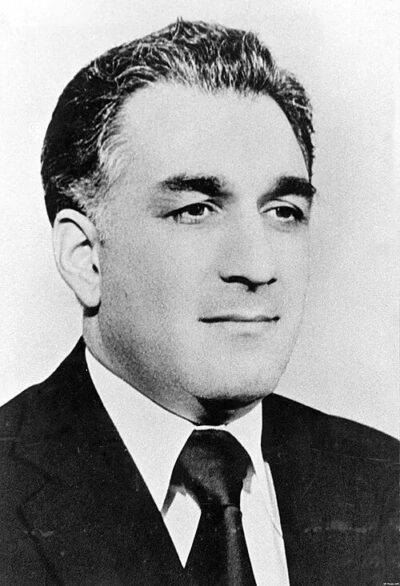
Hafizullah Amin
Hafizullah Amin was an Afghan communist revolutionary, politician and teacher. Born August 1, 1929, in Paghman. Died December 27, 1979, in Tajbeg Palace. Positions held include Chairman of the Revolutionary Council of Afghanistan (1979), Ministry of Defense (1979) and Prime Minister of Afghanistan (1979). Educated at Columbia University and Teachers College.
Facts
17 facts · 2 confirmed by two sources · 2 cited · 13 from one source
Where this comes from
Papalocal keeps its own record. It started from these sources; what each one said is kept here as it was copied, so a change on their side never changes this page by itself. Tap one to read its version.
What Wikidata says · copied November 16, 2026 · revision 2569724574
- Described as
- Afghan communist revolutionary, politician and teacher (1929–1979)
- Other names
- Amin
- Born
- August 1, 1929 · 3 references
- Died
- December 27, 1979 · 3 references
- Born in
- Paghman · 1 reference
- Died in
- Tajbeg Palace
- Buried in
- Tajbeg Palace
- Cause of death
- shot to the head
- Citizen of
- Democratic Republic of Afghanistan
- Occupation
- politician · 1 reference
- Positions held
- Chairman of the Revolutionary Council of Afghanistan (1979); Ministry of Defense (1979); Prime Minister of Afghanistan (1979); President of Afghanistan (1979); Minister of Foreign Affairs of Afghanistan
- Political party
- People’s Democratic Party of Afghanistan
- Education
- Columbia University; Teachers College
- Religion
- Islam
- Wikipedias with a page
- 53
Wikidata item Q63831 (wikidata.org/wiki/Q63831), public domain (CC0). Copied November 16, 2026.
What Wikipedia says · copied November 16, 2026 · revision 1385557659
Hafizullah Amin (Pashto: حفيظ الله امين; 1 August 1929 – 27 December 1979) was an Afghan revolutionary and communist head of state, who served in that position for a little over three months, from September 1979 until his assassination. He organized the Saur Revolution of 1978 and co-founded the Democratic Republic of Afghanistan (DRA), ruling Afghanistan as General Secretary of the People's Democratic Party.
Born in the town of Paghman in Kabul Province, Amin studied at Kabul University and started his career as a teacher before he twice went to the United States to study. During this time, Amin became attracted to Marxism and became involved in radical student movements at the University of Wisconsin. Upon his return to Afghanistan, he used his teaching position to spread socialist ideologies to students, and he later joined the People's Democratic Party of Afghanistan (PDPA), a new far-left organization co-founded by Nur Muhammad Taraki and Babrak Karmal. He ran as a candidate in the 1965 parliamentary election but failed to secure a seat, but in 1969 became the only Khalqist elected to parliament, increasing his standing within the party.
Amin was the main organizer of the April 1978 Saur Revolution, which overthrew the government of Mohammad Daoud Khan and formed a pro-Soviet state based on socialist ideals. Being second in chief of the Democratic Republic, Amin soon became the regime's strongman, the main architect of the state's programs including mass persecution of those deemed counter-revolutionary. A growing personal struggle with General Secretary Taraki eventually led to Amin wrestling power away then successfully deposing him and later ordering his execution; on 16 September 1979, Amin named himself Chairman of the Council of Ministers (head of government), Chairman of the Revolutionary Council (head of state), and General Secretary of the PDPA Central Committee (supreme leader).
Amin's short-lived leadership featured controversies from beginning to end. His government failed to solve the problem of the population revolting against the regime as the situation rapidly worsened and army desertions and defections continued. He tried to change things with friendly overtures to the United States, although his reputation in Washington was severely tarnished by his role in the assassination of U.S. Ambassador to Afghanistan Adolph Dubs. Many Afghans, especially those from rural areas, held Amin responsible for the regime's harshest measures, such as ordering thousands of executions. Thousands of people disappeared without a trace during his time in office. The Soviet Union under Leonid Brezhnev was dissatisfied with and mistrusted Amin after he conducted a series of purges against the Parcham; they intervened in Afghanistan, invoking the 1978 Twenty-Year Treaty of Friendship between Afghanistan and the Soviet Union. Soviet operatives assassinated Amin at the Tajbeg Palace on 27 December 1979 as part of Operation Storm-333, kickstarting the decade-long Soviet–Afghan War.
- Born, in its opening lines
- August 1, 1929
- Died, in its opening lines
- December 27, 1979
From the Wikipedia article “Hafizullah Amin” (en.wikipedia.org/wiki/Hafizullah_Amin), by its contributors, under CC BY-SA 4.0 (creativecommons.org/licenses/by-sa/4.0/). Copied November 16, 2026; not changed.
Confirmed Two sources agree. Cited One source, and it names where it got it. One source One source, without a reference of its own. Sources disagree The sources disagree. We show the best-supported value and keep theirs below.
