
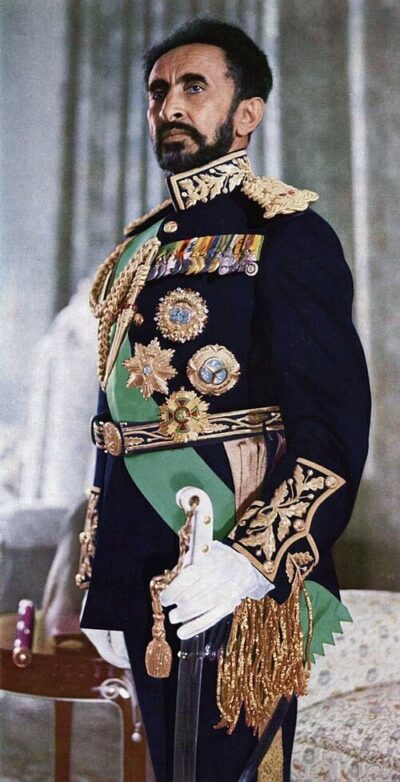
Haile Selassie I
Haile Selassie I was an Emperor of Ethiopia from 1930 to 1974. Born July 23, 1892, in Ejersa Goro. Died August 27, 1975, in Addis Ababa. Positions held include chairperson of the Organisation of African Unity (2 times) (1963–1967), Emperor of Ethiopia (1930–1974) and Minister of Foreign Affairs of Ethiopia. Awards include Grand Cross of the Legion of Honour, Order of the White Eagle and Order of the White Rose of Finland.
Facts
42 facts · 2 confirmed by two sources · 5 cited · 35 from one source
Where this comes from
Papalocal keeps its own record. It started from these sources; what each one said is kept here as it was copied, so a change on their side never changes this page by itself. Tap one to read its version.
What Wikidata says · copied November 16, 2026 · revision 2569627437
- Described as
- Emperor of Ethiopia from 1930 to 1974
- Other names
- Haile Selassie I of Ethiopia, Tafari, Tafari Makonnen, Ras Tafari, Haile Selassie, Lij Tafari Makonnen
- Born
- July 23, 1892 · 9 references
- Died
- August 27, 1975 · 9 references
- Born in
- Ejersa Goro · 2 references
- Died in
- Addis Ababa · 3 references
- Buried in
- Holy Trinity Cathedral
- Cause of death
- strangling · 1 reference
- Name at birth
- Täfäri መኮንን
- Citizen of
- Ethiopian Empire
- Occupation
- politician · 2 references; monarch; ruler · 1 reference
- Positions held
- chairperson of the Organisation of African Unity (2 times) (1963–1967); Emperor of Ethiopia (1930–1974); Minister of Foreign Affairs of Ethiopia
- Awards
- Grand Cross of the Legion of Honour; Order of the White Eagle; Order of the White Rose of Finland; Order of Suvorov, 1st class (1959); Grand Cross of the Order of the Condor of the Andes; Hilal-e-Pakistan (1958); Order of the Nile; Order of the Yugoslavian Great Star; Order of the Star of Romania; United Nations Peace Medal (1972); Knight Grand Cross of the Military Order of William (1954); Collar of the Order of Pope Pius IX; Grand Cross of the Order of the Sun of Peru; Grand Cross Special Class of the Order of Merit of the Federal Republic of Germany (1954); Collar of the Supreme Order of the Chrysanthemum
- Spouse
- Menen Asfaw (1911–1962)
- Children
- Princess Tenagnework of Ethiopia; Amha Selassie; Princess Romanework; Princess Zenebework; Princess Tsehai; Prince Makonnen, Duke of Harar · 1 reference; Prince Sahle Selassie of Ethiopia · 1 reference
- Father
- Mekonnen Welde Mikael
- Mother
- Yeshimebet Ali
- Religion
- Ethiopian Orthodox Tewahedo Church
- Military rank
- general
- Lived in
- Imperial Palace, Addis Ababa · 1 reference
- Wikipedias with a page
- 116
Wikidata item Q41178 (wikidata.org/wiki/Q41178), public domain (CC0). Copied November 16, 2026.
What Wikipedia says · copied November 16, 2026 · revision 1385819965
Haile Selassie I (born Tafari Makonnen or Lij Tafari; 23 July 1892 – 27 August 1975) was Emperor of Ethiopia from 1930 to 1974. He rose to power as the Regent Plenipotentiary of Ethiopia (Enderase) under Empress Zewditu between 1916 and 1930.
Widely considered to be a defining figure in modern Ethiopian history, he is accorded divine importance in Rastafari, an Abrahamic religion that emerged in the 1930s. A few years before he began his reign over the Ethiopian Empire, Selassie defeated Ethiopian army commander Ras Gugsa Welle Bitul, nephew of Empress Taytu Betul, at the Battle of Anchem. He belonged to the Solomonic dynasty, founded by Emperor Yekuno Amlak in 1270.
Selassie, seeking to modernise Ethiopia, introduced political and social reforms including the 1931 constitution and the abolition of slavery in 1942. He led the empire during the Second Italo-Ethiopian War, and after its defeat was exiled to the United Kingdom. When the Italian occupation of East Africa began, he traveled to Anglo-Egyptian Sudan to coordinate the Ethiopian struggle against Fascist Italy; he returned home after the East African campaign of World War II. He dissolved the Federation of Ethiopia and Eritrea, established by the United Nations General Assembly in 1950, and annexed Eritrea as one of Ethiopia's provinces, while also fighting to prevent Eritrean secession. As an internationalist, Selassie led Ethiopia's accession to the United Nations. In 1963, he presided over the formation of the Organisation of African Unity, the precursor of the African Union, and served as its first chairman. By the early 1960s, prominent African socialists such as Kwame Nkrumah envisioned the creation of a "United States of Africa". Their rhetoric was anti-Western; Selassie saw this as a threat to his alliances. He attempted to influence a more moderate posture within the group.
Amidst popular uprisings, Selassie was overthrown by the Derg, a military junta, in the 1974 coup d'état. With support from the Soviet Union, the Derg began governing Ethiopia as a Marxist–Leninist state. In 1994, three years after the fall of the Derg regime, it was revealed to the public that the Derg had assassinated Selassie at the Jubilee Palace in Addis Ababa on 27 August 1975. On 5 November 2000, his excavated remains were buried at the Holy Trinity Cathedral of Addis Ababa.
Among adherents of Rastafari, Selassie is called the returned Jesus, although he was an adherent of the Ethiopian Orthodox Church himself. He has been criticised for his suppression of rebellions among the landed aristocracy (Mesafint), which consistently opposed his changes. Others have criticised Ethiopia's failure to modernise rapidly enough. His administration has been criticised as autocratic and illiberal by groups such as Human Rights Watch. During his reign, the Harari people were persecuted and many left their homes. According to some sources, late into Selassie's administration, the Oromo language was de facto banned from education, public speaking and use in administration, though there was never a law that criminalised any language. His government relocated many Amhara people into southern Ethiopia. In recent years, there has been a major resurgence in defense of and nostalgia for Selassie’s reign over the Ethiopian Empire, and even outright support of constitutional monarchism.
- Born, in its opening lines
- July 23, 1892
- Died, in its opening lines
- August 27, 1975
From the Wikipedia article “Haile Selassie” (en.wikipedia.org/wiki/Haile_Selassie), by its contributors, under CC BY-SA 4.0 (creativecommons.org/licenses/by-sa/4.0/). Copied November 16, 2026; not changed.
Confirmed Two sources agree. Cited One source, and it names where it got it. One source One source, without a reference of its own. Sources disagree The sources disagree. We show the best-supported value and keep theirs below.
