
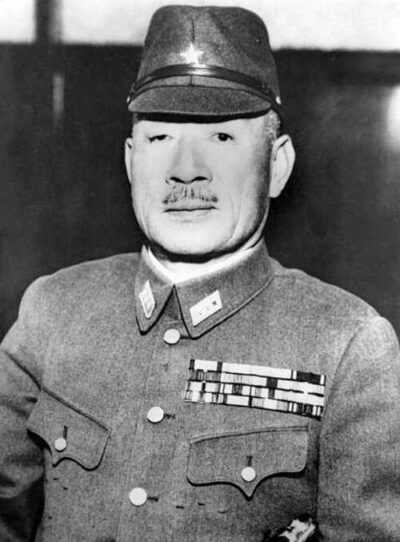
Hajime Sugiyama
Hajime Sugiyama was an Imperial Japanese field marshal. Born January 1, 1880, in Kokura. Died September 12, 1945, in Tokyo. Educated at Imperial Japanese Army Academy. Awards include Order of the Golden Kite, 1st Class.
Facts
12 facts · 2 confirmed by two sources · 0 cited · 10 from one source
Where this comes from
Papalocal keeps its own record. It started from these sources; what each one said is kept here as it was copied, so a change on their side never changes this page by itself. Tap one to read its version.
What Wikidata says · copied November 17, 2026 · revision 2521657479
- Described as
- Imperial Japanese field marshal (1880–1945)
- Born
- January 1, 1880 · 2 references
- Died
- September 12, 1945 · 2 references
- Born in
- Kokura
- Died in
- Tokyo
- Buried in
- Tama Cemetery
- Citizen of
- Japan
- Occupation
- military personnel; politician · 1 reference
- Education
- Imperial Japanese Army Academy
- Awards
- Order of the Golden Kite, 1st Class (1942) · 1 reference
- Military branch
- Imperial Japanese Army · 1 reference
- Military rank
- general
- Wikipedias with a page
- 25
Wikidata item Q982206 (wikidata.org/wiki/Q982206), public domain (CC0). Copied November 17, 2026.
What Wikipedia says · copied November 17, 2026 · revision 1385991340
Hajime Sugiyama (杉山 元, Sugiyama Hajime / Sugiyama Gen; 1 January 1880 – 12 September 1945) was a Japanese field marshal and one of Japan's military leaders for most of the Second World War.
As Army Minister, Sugiyama was a driving force behind Japan's 1937 invasion of China in retaliation for the Marco Polo Bridge Incident. After being named the Japanese Army's Chief of Staff in 1940, he became a leading advocate for expansion into Southeast Asia and preventive war against the United States.
Upon the outbreak of hostilities in the Asia-Pacific theater of World War II, Sugiyama served as the army's commander-in-chief until his removal by Prime Minister Hideki Tojo in February 1944. Following Tojo's ouster in July 1944, he once again held the post of Army Minister in Kuniaki Koiso's cabinet until its dissolution in April 1945. Ten days after Japan's surrender on 2 September 1945, he committed suicide.
- Born, in its opening lines
- January 1, 1880
- Died, in its opening lines
- September 12, 1945
From the Wikipedia article “Hajime Sugiyama” (en.wikipedia.org/wiki/Hajime_Sugiyama), by its contributors, under CC BY-SA 4.0 (creativecommons.org/licenses/by-sa/4.0/). Copied November 17, 2026; not changed.
Confirmed Two sources agree. Cited One source, and it names where it got it. One source One source, without a reference of its own. Sources disagree The sources disagree. We show the best-supported value and keep theirs below.
