
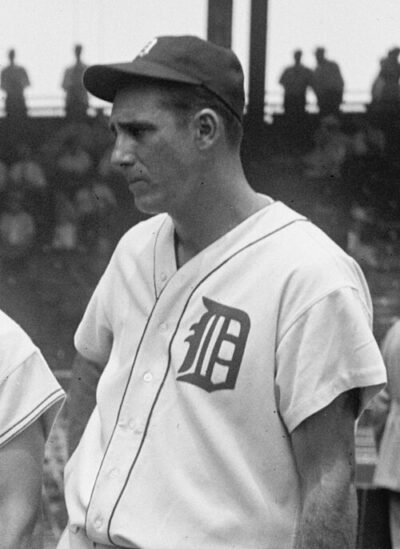
Hank Greenberg
Hank Greenberg was a Baseball outfielder. Born January 1, 1911, in New York City. Died September 4, 1986, in Beverly Hills. Teams include Detroit Tigers and Pittsburgh Pirates. Educated at New York University and James Monroe High School. Awards include Major League Baseball Most Valuable Player Award (2 times).
Facts
17 facts · 2 confirmed by two sources · 5 cited · 10 from one source
Where this comes from
Papalocal keeps its own record. It started from these sources; what each one said is kept here as it was copied, so a change on their side never changes this page by itself. Tap one to read its version.
What Wikidata says · copied November 18, 2026 · revision 2567895552
- Described as
- Baseball outfielder (1911–1986)
- Other names
- Henry Benjamin "Hank" Greenberg, Henry Benjamin Greenberg
- Born
- January 1, 1911 · 2 references
- Died
- September 4, 1986 · 2 references
- Born in
- New York City · 1 reference
- Died in
- Beverly Hills · 1 reference
- Buried in
- Hillside Memorial Park
- Cause of death
- cancer
- Citizen of
- United States
- Occupation
- baseball player · 1 reference
- Education
- New York University; James Monroe High School · 1 reference
- Teams
- Detroit Tigers; Pittsburgh Pirates
- Sport
- baseball · 1 reference
- Awards
- Major League Baseball Most Valuable Player Award (2 times) (1935, 1940) · 1 reference
- Spouse
- Linda Douglas · 1 reference; Caral Gimbel
- Children
- Glenn H. Greenberg · 1 reference
- Wikipedias with a page
- 17
Wikidata item Q687282 (wikidata.org/wiki/Q687282), public domain (CC0). Copied November 18, 2026.
What Wikipedia says · copied November 18, 2026 · revision 1380173639
Henry Benjamin Greenberg (January 1, 1911 – September 4, 1986), nicknamed "Hammerin' Hank", "Hankus Pankus", and "the Hebrew Hammer", was an American professional baseball player and team executive. He played in Major League Baseball (MLB), primarily for the Detroit Tigers as a first baseman in the 1930s and 1940s. A member of the Baseball Hall of Fame and a two-time Most Valuable Player (MVP) Award winner, he was one of the premier power hitters of his generation and is widely considered one of the greatest sluggers in baseball history.
Greenberg played the first twelve of his 13 major league seasons for Detroit; with the Tigers, he was an All-Star for four seasons and was named the American League (AL) Most Valuable Player in 1935 and 1940. He had a batting average over .300 in eight seasons, and won two World Series championships with the Tigers (1935 and 1945). He was the AL home run leader four times and his 58 home runs for the Tigers in 1938 equaled Jimmie Foxx's 1932 mark for the most in one season by anyone other than Babe Ruth, and tied Foxx for the most home runs between Ruth's record 60 in 1927 and Roger Maris' record 61 in 1961. Greenberg was the first major league player to hit 25 or more home runs in a season in each league, and remains the AL record-holder for most runs batted in in a single season by a right-handed batter.
When the United States joined World War II, Greenberg was the first major leaguer to join the armed forces; he spent 47 months in military service, more than any other major league player, all of which took place during what would have been prime years in his major league career. Like many players who served in WWII, his career statistics suffered because of the war and would have certainly been higher had he not served in the armed services during wartime. In 1947, Greenberg signed a contract for a record $85,000 salary before being sold to the Pittsburgh Pirates, where he played his final MLB season that year. After retiring from playing, Greenberg continued to work in baseball as a team executive for the Cleveland Indians and Chicago White Sox.
Greenberg was the first Jewish superstar in American team sports. He attracted national attention in 1934 in the middle of a pennant race when he grappled with the decision of whether or not to play baseball on the Jewish High Holy Days; after consultation with his rabbi, he decided to play on Rosh Hashanah, but refused to play on Yom Kippur, instead spending the day at the synagogue. Having endured his share of antisemitic abuse in his career, Greenberg was one of the few opposing players to publicly welcome African-American player Jackie Robinson to the major leagues in 1947.
- Born, in its opening lines
- January 1, 1911
- Died, in its opening lines
- September 4, 1986
From the Wikipedia article “Hank Greenberg” (en.wikipedia.org/wiki/Hank_Greenberg), by its contributors, under CC BY-SA 4.0 (creativecommons.org/licenses/by-sa/4.0/). Copied November 18, 2026; not changed.
Confirmed Two sources agree. Cited One source, and it names where it got it. One source One source, without a reference of its own. Sources disagree The sources disagree. We show the best-supported value and keep theirs below.
